|
Scottish Archive Network
Project Evaluation Report
(view PDF
version)
21 April 2004
Edited by
Rob Mildren
Project Manager
ISBN: 1 870874 49 8
1. Summary : What has
the SCAN Project achieved?
The Scottish Archive Network
or SCAN project, a £4 million initiative
supported by the Heritage Lottery Fund, has
put Scotland's archival heritage on the Internet
and provided a model for access to archives
in the twenty first century. It has created
a virtual archive service, combining three elements:
- catalogues of the holdings
of nearly every Scottish archive service;
- a suite of reference services,
aimed at helping both the beginner and the
experienced user of archives;
- a complete archive resource
in digital form, 2.5 million images of all
Scottish wills before 1901.
Three quarters of the project
funding came from the Heritage Lottery Fund,
with the balance coming equally from the National
Archives of Scotland and the Genealogical Society
of Utah. The project has taken just four and
a half years to complete and has cost £3.8
million, making it just under budget. It has
employed a total of 79 people, either full time
or part-time, and they have contributed a total
of 111 person years work.
The project has created or
collected catalogue entries for over 29,000
archive collections across fifty two archive
services. These give a summary of holdings,
with dates, and contact information. The reference
services include a knowledge base of 1,000 key
entries on Scottish archives and history, virtual
exhibitions and an interactive course on early
Scottish handwriting. There are also a series
of educational resources aimed at schools. The
wills are accessed via a newly created index,
searchable by name and date, which allows the
customer to jump straight to the digital image
in seconds.
In order to make the project
sustainable, images of wills downloaded from
the Internet are charged for, though they are
free to view in the search rooms of the National
Archives of Scotland. All other services, including
the wills index, are free.
The project was planned and
led by the National Archives of Scotland, while
the Genealogical Society of Utah provided volunteer
staff to capture the digital images and work
on indexing.
One of the project's major
achievements has been to develop a system to
allow high volume, high quality image capture
from original archive documents, while safeguarding
them through skilled conservation input. It
has also changed the balance of access to archives,
with help services controlled by the customer
in place of the traditional archivist.
There are six areas in which
SCAN has achieved significant progress.
1.1 Digitisation
SCAN has developed what is
believed to be the largest and fastest digitisation
operation from original archive documents anywhere
in the world. The achievement has been threefold.
- First is the development
of workflow procedures, including conservation
treatments and pagination before scanning,
careful handling protocols during scanning,
and phase boxing afterwards.
- Second is the development
of image management software with GSU experts,
including a quality control system to minimise
the time documents were under the scanner.
- Third is using skilled
archivists to ensure the links from images
to index entries were correct.
After several months delay
as suitable equipment was procured and workflow
systems were perfected, the project digitised
three million pages of archive documents in
thirty six months. This rate of image capture
puts digitising documents on demand within reach
for the first time, and NAS will be building
on the lessons learned in the project. As a
result of the work SCAN has done, it is possible
to envisage an entirely remote access service
for archives, in which customers select documents
from the catalogue, then order digital copies,
which can be scanned and delivered to them in
about the same time as it takes to order a document
in a traditional archive. This is of potentially
enormous importance to archive services across
the world.
1.2 Catalogues and Standards
SCAN's second major achievement
has been to produce a single union catalogue
of all Scotland's archives at the collection
level. This puts Scotland ahead of other parts
of the United Kingdom, in terms of coverage
and consistency, and provides a model that is
now being copied elsewhere. The components of
this achievement are again threefold.
- First is the development
of a set of guidelines for archive listing
at the collection level in Scotland, based
on international standards. This is the first
time there has been a comprehensive standard
for archive cataloguing in Scotland and has
already improved consistency of description
and raised professional awareness of standards.
- Second is the application
of these guidelines by project staff across
diverse record holdings, helping to transfer
skills and increase the expertise of Scotland's
archivists in description and the application
of national and international standards.
- Third is the implementation
of a catalogue database that could be used
by the project's central server, and also
by participating archives. Use of a common
system by over half the participating archives
helps promote common cataloguing standards,
makes future updating of catalogues easier
and provides an invaluable building block
for further development of item level electronic
catalogues in Scotland.
Although the project changed
its strategy mid-way, adapting an off the peg
product rather than developing its own system,
the overall result has been to significantly
improve access to Scotland's archival heritage,
and help Scotland's archives to position themselves
to benefit from future UK networking initiatives.
1.3 Marketing and e-Commerce
The SCAN project has broken
new ground in applying business techniques to
identify a market for electronic delivery of
archival images, and to exploit it. The project
began with an untested assumption that there
would be a ready market for the digitised wills.
The experience of the NAS search rooms was that
around 1,000 copies of wills per year were produced,
for personal and postal enquirers, but the project
hoped that more knowledge of the wills, and
easier access would improve this. Marketing
research, with the assistance of Lothians Enterprise
and seconded students from Heriot Watt University,
indicated that the market might be more substantial
and that people would be perfectly willing to
pay for a full colour, high resolution image
delivered to them. The project has gone on to
develop a thriving e-commerce facility that
is selling as many images of wills per month
as the NAS sold in a year, and with every sign
of continuing growth in sales.
1.4 Genealogical Tourism
The project did not set out
to specialise in genealogy, but it recognised
early on that this was probably the single biggest
growth factor in the use of archives. It is
also one with significant potential to contribute
to economic development, through stimulating
tourism. SCAN staff worked with representatives
of VisitScotland and local tourist interests
to link their site to those targeting visitors
to Scotland. This raised the awareness of both
those holding archives and those promoting tourism,
of the potential of the genealogical tourism
market to Scotland, and the value of collaboration.
SCAN has also led to a further initiative to
develop ScotlandsPeople, a single official family
history service for Scotland, at both national
and local level. Genealogical tourism can be
a potent argument for archivists at every level,
showing a real connection between the care of
the documentary heritage and economic growth.
1.5 Benefiting the Archive
Community
The project has made a significant
contribution to the capacity of Scottish archives.
In addition to promoting awareness of standards,
it has provided PCs and Internet connections
to a number of Scottish archives that did not
have them before. A total of 34 participating
archives benefited. It provided associated ICT
training that boosted archivists' knowledge,
skills and confidence. It continues to provide
specific help to some archives, including hosting
microsites, digitising documents, and hosting
virtual exhibitions. The ability of Scotland's
archivists to respond to customer enquiries
has been widened by the availability, for the
first time ever, of a union catalogue and high
quality on-line reference materials on Scottish
archives and history.
1.6 Benefiting the Archive
Customer
SCAN has created an archive
website that mirrors the facilities of a physical
service. Much attention has been paid to developing
self-help services, allowing the visitor to
access catalogues and reference materials, answer
questions whether simple or complex, view exhibitions
and educational material on-line, and order
digital images of documents. This is now a tried
and tested model for the development of archive
services in the twenty first century.
The most obvious achievement
of the SCAN project is that it has created a
website which showcases Scotland's rich archival
heritage and is extremely popular. It recorded
over one million unique visitors over the past
year, which is several times greater than the
total of people making physical visits to Scotland's
archives.
2. Project Rationale
2.1. Project Background
Access to Scottish archives
has been restricted as many archive users have
found it difficult to establish what archived
information was available and identify where
that information may be located. The fact that
much of this information was only available
within central Edinburgh and that old paper
catalogues could be very difficult to use, owing
to their size and complexity, often compounded
this problem.
To redress this situation
the Scottish Archive Network (SCAN) project
sought to open up access to the rich written
heritage of the nation by creating a digital
medium through which information could be more
easily located and retrieved. To this end SCAN
set out to create a virtual search room for
Scottish archives, which would provide digital
access to the top level finding aids for every
archival institution which had agreed to participate
in the project. In addition, an electronically
searchable 'knowledge-base' of Scottish history
was also created to assist researchers in their
exploration of Scotland's past. A further aspect
of the project ensured that all the wills and
testaments registered in Scotland between 1500
and 1901 were digitally imaged and linked to
an electronic index, making this major primary
source of Scottish history more widely available
to family history and genealogical researchers.
All of these services were developed to be remotely
accessible via the Internet. By the end of the
project fifty two public and private archives
from across the length and breadth of Scotland
had joined the SCAN project, the largest of
which was the National Archives of Scotland
(NAS).
Core funding for the project
of £2.9 million was awarded by the Trustees
of the Heritage Lottery Fund (HLF) while the
required partnership funding of £1 million
was jointly provided by the NAS and the Genealogical
Society of Utah (GSU).
The project's objectives,
as detailed in the Project
Implementation Document, were as follows:
2.2. Project Objectives
- to create an electronic
search room for fifty two participating Scottish
archives.
- to collect the top level
finding aids of the participating archives
as they existed in the year 2000; to convert
them to the International Standard for Archival
Description (ISAD(G)) and into electronic
form; to provide electronic links to more
detailed electronic catalogues, if they exist,
or to state that more detailed catalogues
exist only on paper; and to make this information
available and searchable electronically over
the Internet.
- to construct a knowledge
data base of 1,000 key themes of Scottish
history from sources in participating archives
and make it searchable electronically over
the Internet.
- to develop a range of
other services to enhance the electronic search
room, including exhibitions, discussion forum,
and archive directory, all searchable electronically
over the Internet.
- to develop the existing
electronic catalogues of the National Archives
of Scotland and make the top level finding
aids of 1,000 of their major fonds available
over the Internet.
- to create digital images
and convert the various indexes to Scottish
testaments, 1500-1875, to electronic form
and link them electronically to digital images
of the testaments.
- to improve the preservation
conditions of the original testaments.
This report, therefore, sets
out to provide both a critique and evaluation
on the technical, financial and preservation
implications of large-scale digitisation of
archive material, in the light of the project
experience.
3. Defined Method of
Approach
The project utilised the Prince
2 management methodology, adapted for the specific
needs of the project, and was split intellectually
and practically, into two separate parts:
- The creation of the products
needed to create the infrastructure of the
Scottish Archive Network.
- The subsequent exploitation
and expansion of these initial products.
At a practical level the project
was further sub-divided into the following four
sub-projects:
- Online Catalogues
- Internet Resources
- Wills & Testaments
- Information Technology
& Communications.
3.1. Project Deliverables
and Outcomes
The top level finding
aids (i.e. the fonds level finding aids) of
all fifty two participating archives, were converted
to ISAD(G) and into electronic form, electronic
links were provided to more detailed catalogues,
if they existed in electronic form, or statements
that more detailed catalogues existed only on
paper.
- A knowledge data base
of 1,000 key themes in Scottish history, covering
450 subjects, 250 places, 250 people and 50
'how to's' was created and made available
over the Internet.
- An electronic discussion
forum, virtual exhibition space, and archive
directory, were created and made available
over the Internet.
- The existing electronic
catalogues of the National Archives of Scotland
at file/bundle/item level were made available
over the Internet.
- 600,000 index entries
to Scottish testaments, 1500-1901, were converted
to electronic form and (currently) 460,000
have been linked to digital images of the
testaments.
- 1.8 million digital images
of approximately 3.5 million pages of testaments
have been prepared, captured, quality controlled,
stored and made available.
- The SCAN and ScottishDocuments.com
websites were designed to be available 24
hours a day, 365 days a year and have attracted
over 1 million visitors.
- The original paper testaments
were placed in phase boxes and withdrawn from
public consultation.
3.2. Project Harmonisation
Although there was no obligation
for harmonisation between the SCAN project and
other archival projects, much work has been
carried out to allow a UK network to be formed
in future . This has concentrated on the archival
aspects of potential future networks rather
than the technological aspects. This has now
placed SCAN as an integral part of the plan
for the development of a UK wide National Archive
Network and laid the foundations for more extensive
catalogue conversion in the Mac2A project.
Joint work on name authority
files was carried out with the then Public Record
Office and the National Register of Archives
and SCAN is currently represented on the committees
of all the various networking initiatives. SCAN
also worked closely with the Higher Education
(HE) Hub to ensure that new cataloguing paid
for by the Hub, in Scottish universities, was
in a format which could be successfully integrated
into SCAN and vice versa.
4. Project Interfaces
4.1 National Archives
of Scotland (NAS)
SCAN worked closely with
the NAS Historical Search Room in withdrawing
the testaments from public use and providing
surrogate copies. Although this was seen as
a potential area of difficulty few complaints
from the public were received. This was due
to the publication of careful explanations and
detailed timetables in the Search Room and by
SCAN holding a series of meetings with record
agents and readers to discuss relevant issues.
SCAN worked closely with the record cataloguing
branches to compile the new NAS top level finding
aid to replace the existing Summary Catalogue.
Through extensive consultation with all the
participating archives and with other archives
in the UK, the project was instrumental in creating
and introducing cataloguing guidelines, with
the result that Scotland has now for the first
time an agreed cataloguing standard at fonds
level.
SCAN worked closely with the NAS Outreach and
Education Branch in providing facilities for
electronic exhibitions and publications. SCAN
took the lead in website design and passed on
the knowledge and experience gained through
this process to the NAS who were able to use
this information to successfully design their
own website. Both the SCAN and the NAS websites
share the same platform.
4.2 Descriptive Standards
One of the aims of the project,
which has been fully achieved, was to develop
a Scotland-wide catalogue of archives. An essential
part of this was developing a set of agreed
standards for cataloguing. Archives have come
relatively late to standards and the tendency
until recently was for individual institutions
to develop their own house rules. Differences
in rules mattered little, since the user had
to visit the archive, and the local system could
then be explained. With the arrival of the Internet
and the opportunity for catalogue data to be
shared with other institutions and with a public
that did not necessarily visit, the need for
standards became clear. The pioneering development
in the 1990s was a data structure standard produced
by the International Council on Archives (ICA),
known as the International Standard Archival
Description (General) or ISAD(G). The second
edition was issued in 2000. ISAD(G) was followed
by another structure standard, with some content
rules, for describing individuals and groups,
the International Standard Archival Authority
Record for Corporate bodies, Persons and Families
or ISAAR(CPF). At about the same time, the UK
National Council on Archives produced a set
of rules for describing personal place and corporate
names, which parallels and complements the ISAAR
standard.
One of the strengths, but
simultaneously one of the weaknesses of the
ISAD and ISAAR standards is that they are relatively
easy to comply with. They were an essential
pre-condition for exchanging and sharing catalogue
data, but they did not of themselves provide
a means of exploiting electronic cataloguing.
A North American group, led by Daniel Pitti,
recognising the potential of markup languages
and the power of document type definitions,
produced Encoded Archival Description (EAD).
The second and subsequent editions of this are
directly linked to ISAD, and provide a means
of coding ISAD structured descriptions.
SCAN recognised the importance
of international standards and decided at the
outset to use ISAD and ISAAR. However, it was
less clear on the value of EAD. On the one hand,
we saw its potential to help users target their
searches, but on the other, we were concerned
about the additional cost in tagging entries
and how to deal with huge legacies of untagged
material. In order to clarify matters, the project
sponsored an international conference in September
1999, and invited a number of prominent speakers,
including Pitti. The conference crystallised
thoughts and led to the conclusion that SCAN
would not use EAD as an input format, but it
would seek to build it in as an export format,
in other words, it would keep the option of
producing EAD records from its catalogues. A
report on the conference is given at [link
to conference report].
The question of data
content remained, however. It was realised that
the project would need to develop guidelines
applicable across Scotland, across the different
types of record encountered in all the participating
archives, and consistent with the software packages
in use. SCAN had one big advantage, it had its
own dedicated team of cataloguers, rather than
gathering other people's catalogues as, projects
such as the HE Hub and A2A did. This made it
much easier to develop a set of data content
standards. The decision to use the CALM cataloguing
software, and the wide take up by participating
archives, further helped to promote a standard
approach to cataloguing. Catalogue standards
have been published on the SCAN
website. The benefits have been felt already
in the consistency of entries across diverse
archives in Scotland, and they will go on being
felt, as catalogues are extended to item level.
The main benefit, ultimately, will be for the
user, who will find it easier to navigate and
find resources.
4.3 International
SCAN has set a welcome precedent
in leading the way in Scotland in the adoption
of the agreed definitions, terminology and standards
of the International Council on Archives and
in the implementation of the name authority
standards of the National Council on Archives.
The project has also made a significant contribution
to the European Union Archive Network, more
information on which can be found at www.euan.org.
4.4 Genealogical Society of
Utah (GSU)
There will be a significant
legacy for the archive community in the work
SCAN has undertaken with the GSU. In solving
the problems that all archives will face in
planning conversion of original historical material,
SCAN and GSU have developed solutions that can
safely address the key issues of preservation
and access. In addition the working relationship
between the GSU and SCAN project has already
led to the GSU committing more volunteer resources
to digitise the Kirk Session records in Scotland.
5. Assumptions
The project assumed the continuing
support of the HLF, the NAS and the GSU and
at the levels given in the cost summary attached
to the project submission in the original PID.
It assumed that the HLF would agree contracts
and make payments timeously and would answer
requests for decisions within two weeks of receiving
the request. Although these assumptions have
proved generally correct, the HLF have not always
answered requests for decisions within two weeks.
The relationship with HLF
stretches over seven years. The first significant
contact came as a result of the initial application
for funding. Dr Barnes and Rob Mildren met with
Seamus Ross (HLF IT Advisor) and Jane Stancliffe
(HLF Senior Case Officer) in June 1996 to discuss
the initial application. Following advice and
encouragement from HLF representatives, the
project was re-designed and submitted again
in 1998.
Throughout the lifetime of
the SCAN project, the HLF has closely monitored
progress and assigned not only a case officer
but also two project monitors, Mike Smethurst
and Seamus Ross. They have been responsible
for monitoring the monthly reports and for advising
the HLF on the direction taken by the SCAN project
team. In addition there have been regular (quarterly)
meetings involving the case officer, project
monitors and senior project staff. In this way
the project monitors have been intimately involved
in many of the key decisions regarding the project.
It would be fair to say that the relationship
was not always smooth. There was a very fine
line to tread between monitoring the project
and directing the project. This caused severe
friction when dealing with the issue of image
quality but proved far more positive on the
issue of the educational content of the website.
It should be recognized that the HLF showed
a great deal of faith and foresight in supporting
the SCAN project which, at the time, was based
on largely unproven technology and concepts.
The counterbalance to this was to ensure that
the levels of monitoring were high and that
there was a reliance on performance indicators
which were often difficult to establish or measure.
Over the later years, however, the relationship
has improved significantly as the production
of quantifiable deliverables has increased.
The support of the Genealogical
Society of Utah has in practice far exceeded
their legal obligations. The GSU were approached
primarily for a cash contribution towards the
project to help with the partnership funding.
After initial discussions it was clear the GSU
too were considering digital technology as an
alternative to their microfilm projects and
that this would be an ideal opportunity for
them to become fully involved and learn more
about the implications for a digital project
as opposed to a microfilm project.
GSU agreed to supply the eleven
staff that had been identified as necessary
for the digital capture of the testaments. They
would supply a full time supervisor and five
volunteer couples. GSU had been experimenting
with a camera and software that would simplify
the image capture process. They agreed to produce
colour images and adapted the software to produce
a very high quality colour image from a greyscale
camera taking three images shot separately through
red, green and blue filters. The software provided
a major breakthrough in the project. Not only
would the throughput be high but the software
would handle other aspects of the capture process
such as the file naming, storing and creation
of process metadata. This simplified the operator
involvement, reduced operator training times
and reduced operator error. They supplied one
camera for the project along with the software
(dCam). This proved so successful that, when
the open procurement competition failed to provide
an effective alternative, it formed the blueprint
for the camera configuration that successfully
completed the digitisation of the testaments
within budget and timescale.
The relationship with the
GSU throughout the project remained very good.
The contract negotiations allowed the archive
to address the key issues of document handling
and training. The GSU agreed that all their
staff would abide by SCAN handling guidelines
and underwent training in advance of working
with the original material. Weekly meetings
with the GSU supervisor ensured that the workplan
was well known to both sides and issues could
be dealt with quickly. Senior GSU staff also
showed a great deal of interest in the project
and frequently met with SCAN project staff.
The GSU were able to benefit from the practical
experience gained as well as the establishment
of a successful workflow, lessons that they
were subsequently able to extend to more digital
imaging projects.
The assumption that all participating
archives would actively support the project
proved correct, although some took longer to
commit to the project than others.
With guidance from the HLF,
SCAN established a Participating Archives Working
Group. This group was to act as both a sounding
board for project ideas and also as a lobby
group for the majority of archives who were
sceptical about the overwhelming influence that
the National Archives of Scotland (NAS) would
exert on the project. The forum itself only
met infrequently but meetings were also held
with the full group of participating archives.
The most positive outcome of these was the decision
to extend the CALM licensing that the NAS had
selected to interested participating archives.
This initiative was supported by the HLF monitors
and made a significant impact. More than 20
archives now have the same cataloguing software,
have had training and can maintain and enhance
the catalogue entries created during the project.
The rollout of licences was successfully completed
and was very well received. In addition to the
PCs that had been supplied earlier in the project
these were significant and tangible assets for
the archive community in Scotland and create
an excellent foundation for further development.
The participating archives played an essential
role and have now taken responsibility for the
next major development in Scottish archive catalogues
with the application for the Mac2A project.
A number of archive institutions
also sought to join the partnership during the
life of the project raising the total number
of participating archives from forty five to
fifty two by the end of the project.
The assumption that the NAS
would wholly support the project proved problematic.
NAS fully supported the project at a senior
management level, but in practice there was
confusion and scepticism over the aims of the
project, and how it dovetailed with other NAS
activities. In areas where the project was doing
identical work to NAS, such as conservation,
this took time to resolve.
The Historical Search Room
was cooperative in withdrawing the testaments
from public use and providing surrogate copies
and NAS staff employed in all the record cataloguing
branches played a valuable role in compiling
the new NAS top level finding aid to replace
the existing Summary Catalogue. Although staff
from Outreach and Education Branch made a valuable
contribution in terms of providing access to
material for electronic exhibitions and publications,
their support was not as critical as previously
assumed. Full cooperation between existing NAS
conservation staff and SCAN conservation staff,
however, took longer than anticipated to develop.
In retrospect it may have been a more satisfactory
solution for SCAN to have commissioned the necessary
conservation resource direct from NAS. This
would have allowed the NAS conservation team
greater flexibility in deploying its staff and
meeting the targets set by the SCAN project.
While the NAS had agreed to
provide suitably qualified staff on secondment
to the project, as and when necessary, it was
found that while the NAS has been willing to
carry out its obligations it had been unable
to do so because of the lack of availability
of suitably qualified staff. The difficulty
SCAN has had in appointing and retaining suitably
qualified staff has been mirrored in the NAS
itself. This has also had a major impact on
the online catalogues sub-project.
There appear to be several
key reasons for the high turnover
- younger archival staff
are keener to develop a 'portfolio' career
whereby they build experience by spending
shorter periods in more varied posts
- archival staff who had
recently left University with student debt
were keener to accept short contracts where
the salary was higher rather than rely on
a slower, reliable progression within a pay
band
- there were a lot of attractive
archival projects underway at the same time
- new staff wanted to work
on a wider range of activities
Relations with the NAS relied
heavily on the continued support of senior management,
particularly the former and current Keepers,
Patrick Cadell and George MacKenzie. The view
assumed by many participating archives was that
the project was seen as wholly owned by NAS.
In direct contrast to this, many staff in NAS
were suspicious of SCAN. Whilst the decision
to house the full project team at TTH was essential
in fostering the good team spirit and level
of communication evident within the SCAN project,
it meant that the many NAS staff would see it
as distant and separate from their day to day
activities. This underlined the case that SCAN
was indeed additional to the NAS but also fostered
a reluctance to co-operate unreservedly.
Staff, personnel and welfare
matters were mainly handled by the Scottish
Executive Human Resources Division throughout
the project, although in some instances it was
more convenient for the project to engage casual
staff directly in order to overcome restrictive
Scottish Executive recruitment policies. This
approach was encouraged by the HLF monitors
and was an invaluable source of flexibility
when dealing with staffing issues.
It was assumed that
all public orders relating to copies of wills
that have been digitised were dealt with by
SCAN staff and the revenue earned from these
transactions was retained by the project.
6. Social & Political
Context
6.1 The Scottish Archive Community
Scotland has a diverse arrangement
of archive services. In addition to the national
institutions, the NAS and the National Library
of Scotland, most of the 32 local authorities
have archives, and, at the time of writing,
others are in the process of setting them up.
There are different models: some services are
predominantly historical, with considerable
expertise in the records of the predecessor
authorities, particularly the older Scottish
burghs. The collections of the cities of Aberdeen
and Dundee, for example, are especially rich.
Other authorities, such as South Lanarkshire,
provide records management services in addition
to looking after older records. Some services
are located directly within the corporate management
structure of the authority, others are managed
along with libraries and in one or two cases
they come under the museum service. In some
cases imaginative joint service arrangements
have been put in place, such as in Ayrshire,
where a single archive serves three local authorities.
There is no statutory basis for the services,
though the Freedom of Information (Scotland)
Act of 2002 is prompting authorities that have
not established archive and record services
to do so. Local authorities have not, in the
past, given particular priority to their archive
services, and funding levels are generally low.
At the outset of the SCAN project, for example,
few had proper ICT facilities and most had no
email or Internet services.
The older universities all
have archives, and many of the newer ones have
also established them. The collections of the
universities vary, but generally include the
institution's own records, papers of eminent
staff, and other material that has been donated
or collected. The University of Glasgow has
particularly extensive holdings of business
archives. The university archives have benefited
in the past few years from funding streams to
develop and enhance research collections. These
have led to higher standards of cataloguing
and better access than in the local authorities.
A few of Scotland's health authorities have
also provided archive services, and two of the
strongest are located in Glasgow and Edinburgh,
using space in the universities, but funded
by local NHS bodies. There are also a range
of specialist archives, ranging from the Scottish
Theatre Archive to the Clan Donald Trust. These
are generally small scale operations with a
single professional archivist, and a range of
funding from voluntary and private sources.
The SCAN project brings together
51 of these diverse services, representing virtually
all the local authorities, all the universities
and health authorities, and all the specialist
archives that have professional archivists in
post.
6.2 Funding Archives
Archives in Scotland, especially
those outside the central government and higher
education sector, have suffered from lack of
attention and funding. An Archival Account of
Scotland in 1999 , produced by a consortium
of national and local archive services, revealed
chronic under-funding leading to poor and unacceptable
practices. Against this background, the funding
from the SCAN project was particularly valuable,
and enabled some local authority archives to
benefit from PCs and Internet connections for
the first time. The publicity which the project
has generated has also helped to focus attention,
by the public and by officials, on the richness
of Scotland's archival heritage and the ways
it can be used for self discovery and learning,
and the promotion of tourism.
On the positive side, Scotland's
archives continue to attract growing numbers
of customers, mainly those interested in the
history of their families, their houses and
their local communities. These now account for
about two thirds of visitors to archive services.
The growth in interest in such personal history
since 1996 has amply justified the decision
to include the wills in the project. The statistics
from the National Archives indicate an increase
in genealogical researchers from 44.5% of the
total researchers to 51.3% over the same period.
6.3 Virtual Access
The emergence of the Internet
as a major feature in public services has occurred
during the period of the project and has helped
it. At the planning stage in the mid 1990s,
delivery of images in real time to users across
the world was barely feasible. Now it is emerging
as one of the main means of access to archives.
SCAN has demonstrated that the technology of
scanning archive documents works, that the model
of the virtual archive, combining catalogues,
reference services and images, works, and that
there is a market for the services it has created.
Scotland's archives, with their collection level
catalogues on the Internet, and with access
to the expertise and facilities for digitising
documents, are in a much better position to
benefit from electronic service delivery as
a result of the project.
6.4 Archives and Education
Archives have a potentially
strong role to play in learning, but this has
scarcely been exploited. One of the reasons
is the difficulty of identifying and interpreting
archive material for use in classrooms. Teachers
generally have insufficient time to do this,
while archivists are unaware of the needs of
educators. Yet the holdings of archives can
be used to illustrate just about any subject,
and of course are of crucial importance in teaching
history. Local archives contain information
on how local communities reacted to past events,
and using this imaginatively can not only help
deepen understanding of what happened and why,
but also strengthen the feeling of personal
and communal identity, aligning the learner
to the past and to a place in a unique way.
The National Archives (TNA) in London has done
pioneering work with its Learning Curve website,
and in Scotland the NAS, along with the Scottish
Executive Education Department and Learning
and Teaching Scotland is developing archives
for schools materials, with teachers working
alongside archivists.
The SCAN project recognised
the value of electronic systems for delivering
learning materials for schools and developed
a number of modules on topics in the history
curriculum. Using scanned documents and other
images, specially written interpretive material,
plus sound and interactive features helps to
bring the past alive. One of the features of
this work was that it was led by teachers in
the User Group, and involved archivists working
with them to identify material from across Scotland.
The final product was professionally produced
by a leading multi-media company, which greatly
enhances its appearance.
6.5 Genealogical Tourism
The growth in interest in
family history has led to recognition of its
potential for developing tourism. This has attracted
considerable attention both nationally and locally.
Research commissioned by VisitScotland, Scottish
Enterprise and Highlands and Islands Enterprise
has revealed that genealogical tourism is a
significant niche market, and one with growth
potential. In 2001, around 0.25 million trips
were made to Scotland motivated by genealogy,
and a further 0.25 million visitors undertook
some genealogical research whilst in Scotland
making a total of around 0.5 million visitors
who undertook some genealogy related activity.
Genealogy-motivated visitors are estimated at
just 2% of all visits to Scotland, but tend
to stay longer and therefore generate almost
5% of total expenditure by holiday tourists.
VisitScotland launched a new website aimed at
ancestral tourists, ancestralscotland.com, in
January 2002. SCAN staff contributed to planning
the new site and ensured links from it to the
SCAN site.
Archives have a crucial role
to play in the development of the genealogical
tourism market. They can help to attract visitors,
they can increase the length and quality of
visits, and they can help visitors identify
the places their ancestors lived in. SCAN helps
promote this, both by its internet presence,
and by offering people the opportunity to do
research before they visit.
7. Progress Measures
A series of key performance
indicators were agreed with the HLF monitors
early in the project and formed part of the
monthly progress reports. Some parts were easier
to measure than others. For the Online Catalogues
project the fact that the total number of fonds
in Scotland was only an estimate and that each
fonds could be very different in the amount
of effort required to prepare meant that it
was difficult to establish a meaningful performance
indicator. In addition, as more of the fonds
were imported from the HE Hub than originally
anticipated, it always appeared that the Online
Catalogues would never meet the completion target.
Other performance indicators, such as number
of images captured, proved relatively simple
to record and monitor.
A project board oversaw the
early parts of the project and the successful
establishment of the digital deliverables. Regular
team leader meetings took over the main role
of measuring progress, planning further developments
and dealing with day to day issues.
In the early days of SCAN,
contact with HLF was direct to the London office.
In 2001, the HLF opened an office in Edinburgh
and subsequently the HLF managed their administration
of the project from there. This was a helpful
move for the project and communication with
the Edinburgh office was much easier. In addition,
regular monitoring meetings were held between
senior SCAN staff and the HLF monitors. These
continued throughout the project at approximately
quarterly intervals. Each year an annual review
was prepared which highlighted progress made
and allowed both the project team and the HLF
monitors to assess where other developments
could be made.
A spreadsheet was developed
which allowed each sub-project to measure its
progress performance against agreed targets
on a monthly basis. This information supplemented
a detailed progress report which was submitted
to the HLF each month.
Appendix 5 provides
a link to all the monthly reports submitted
to HLF.
8. Critical Success
Factors
8.1 Online Catalogues
The online catalogues work
was completed during March 2004, later than
anticipated. The total quantity of entries in
the database was about 30,000, which was at
the top end of our initial expectations. The
delay in completion arose in part because of
the serious impact from late 2000 for about
a year of the lack of availability of appropriately
qualified staff. While this was less of a problem
from end 2001, the section's work was also significantly
impeded in mid-2003 by problems with the archive
management system, CALM, being used in the project.
SCAN did benefit, however from the money being
spent by the HE Hub in producing fonds level
descriptions in university archives. This has
meant that SCAN had much less work to do in
university archives and was able to absorb the
increased number of participating archives.
The NAS also helped SCAN by undertaking some
work on its own catalogues, once its own electronic
catalogue conversion project (e-Cat) started.
This allowed SCAN to concentrate on local authority
archives, specialist archives and the National
Library of Scotland. Once the NAS e-Cat had
begun to deliver, it became easier for us to
work on NAS collections, which formed about
one quarter of the expected total of entries.
SCAN has also concentrated on producing skeleton
entries for commonly-occurring fonds (e.g. records
of county councils, which differ little from
one county to the next) which will both ease
and standardise the subsequent collection of
a whole range of fonds. These were the focus
of discussion for meetings of the Participating
Archives Working Group and this was a helpful
step in reaching a consensus.
When we began the work in
autumn 1999, we had forty five participating
archives within the fold. At the end, we had
fifty two. The increase in numbers is explained
partly by the formation of new publicly-funded
archives (e.g. Fife Council Archives), and partly
by established archives realizing that there
were benefits to association with a nationwide
project (e.g. Archdiocese of Glasgow Archives).
We were happy to accept new participating archives
where we could: the only proviso was if we could
accomplish any collection description work on
new participants in time without impacting excessively
on our long-term partners. We were pleased that
we did manage to keep up with the work across
the board, despite the additional burden, helped
by the extension of the end of project deadline.
By the end of the project, there was a small
number of potential participants, who in an
ideal world we would have welcomed aboard, including
Edinburgh City Archives, Argyll & Bute Council
Archives, and the Bank of Scotland Archives.
The first two were originally unable to participate,
because of the then state of their catalogues
and concern as to an insupportable increase
in archive usage.
One part of the original expected
work for SCAN in its project bid was over taken
by events. We had been expected to "to
develop the existing electronic catalogues of
the National Archives of Scotland and make the
top level finding aids of 1,000 of their major
fonds available over the Internet". NAS
was still examining ways to improve its electronic
catalogue when SCAN started its work. However,
as time passed, it became clear that NAS had
taken full control of its requirements, and
devised its own electronic catalogue acquisition
and conversion project, which was complete in
its original form by end 2003. SCAN had always
been involved in this case, because of the near-certainty
that we and NAS would use the same archive management
system. Indeed, in the course of 2003 it became
clear that NAS was not expecting to have made
significant improvements to its current, mostly
brief fonds level entries, as they would be
improved in the course of subsequent work. Accordingly,
we began to revise as many of the brief entries
as we could, and have undoubtedly fulfilled
our NAS objective as mentioned earlier, even
if not quite in the way anticipated at the start.
The following factors were
deemed to be critical to the success of the
online catalogues sub-project. Each factor is
briefly described first, and subsequent text
develops themes arising.
8.1.1 Obtaining a database
to hold all the data
This was crucial as until
that was in place none of the data could be
made available outside SCAN. The advantage of
being associated with NAS in acquiring the CALM
system was that the NAS influence was essential
in persuading DS Ltd to resolve technical issues:
NAS is DS's biggest customer. The consequence
was that NAS made many of the decisions as to
how CALM is used within NAS/SCAN, including
what elements are displayed within the OPAC,
on which a resolution is still needed.
At the start of the project,
we had been clear that we wished to use the
ARKIS II archive management system created and
developed by the Riksarkivet, the National Archives
of Sweden. Their system was suitable for a Swedish
project similar to SCAN which had been underway
in recent years, and its database was already
available to users online. In comparison, at
the time of development of the SCAN bid for
HLF funding, commercially-available archive
management systems within the UK were not at
that stage robustly tested with large quantities
of data nor capable of being customised, and
it was considered advisable to choose a system
which did work and which could be customised.
We appreciated that the decision to seek an
accommodation with the Riksarkivet had potential
risks: for example, the system's operating code
was inevitably in Swedish, but the Riksarkivet
was keen on making the system available to other,
non-Swedish archives, and would certainly co-operate
on an English-language version. A successful
installation of the system in SCAN, and perhaps
NAS as well, might then lead to its being made
available to other participating archives in
SCAN. Accordingly, once a dedicated IT staff
member was appointed to online catalogues in
spring 2000, a co-coordinated effort was made
to establish exactly what would be required
to develop ARKIS II for SCAN needs. This process
also impacted on the production of the SCAN
cataloguing guidelines, which to work effectively
had to be geared towards what we understood
of the operational requirements of ARKIS
Once better knowledge of how
ARKIS worked internally was available, our IT
staff member developed an MS Access database
to mimic ARKIS routines, the purpose being to
allow a swift migration of our data into ARKIS
once we had our own version of the system. For
ease of reference, the Access database was called
WeeArkis. It was then employed within the project
for data entry, and when combined with the cataloguing
guidelines proved to be very useful in ensuring
that staff used the right fields for their data.
It was quickly appreciated that to allow WeeArkis
to function effectively when staff were as much
away from the office undertaking field-work
as working in the office connected to office
networks, each participating archive required
a separate WeeArkis database. Apart from ease
of use internally, it ought to allow easier
despatch of our data for local review by each
archive. The drawback of this was that we would
not have one unified database. We understood
that a unified database was important when we
were intending to use name authority records
for record creators, as within a unified database
we would have one name authority record potentially
linked to a number of collections with which
the person or body was connected. Lacking a
unified database, staff could not be sure whether
or not another staff member had already compiled
a name authority record for a particular person
or body, with possible duplication of effort.
We estimated that the vast majority of name
authority records we needed would be unique,
and certain record creators anticipated to be
commonly-occurring such as Sir Walter Scott
would be self-evident to all. Concessions to
practical requirements had on occasion to be
made.
What we did not anticipate
was that we would be into the final year of
the project before we obtained a satisfactory,
unified database. There were two reasons in
particular why we took so long to reach that
stage. First, we concluded at the end of 2001
that we could no longer be certain that we could
anticipate sufficient, timeous development of
ARKIS as an English-language option for its
use within SCAN to be practicable. Second, once
we had decided that we should not pursue ARKIS,
we needed a satisfactory alternative, and one
which would be operable within the NAS IT framework.
Although effectively we were back to square
one, we were well aware that NAS was well-advanced
with its expected acquisition of a new archive
management system, and we understood that one
which met NAS's needs would also be capable
of hosting the SCAN data. Accordingly, once
NAS had decided in early 2002 that its best
option (amongst a very small list of candidates)
was the CALM system as developed by DS Ltd,
SCAN agreed that it should acquiesce with NAS.
Given that decision, we therefore
had to prepare ourselves towards fitting our
data into CALM. We could see that the WeeArkis
databases could be migrated into CALM with some
preparatory work. As we were no longer the only
force behind the system acquisition and installation,
we waited until NAS had resolved any pre-purchase
issues and begun the task of identifying how
its own electronic and typescript data could
be migrated into CALM. By end 2002 we were close
to the stage where we could migrate the WeeArkis
databases into CALM. Test migration quickly
revealed that the task had to be postponed,
as in the course of migration the system was
over-writing what it considered to be duplicate
name authority entries, even though in only
a few cases was this actually so. The only alternative
means of migration was to migrate everything
and then eliminate actual duplicate entries
once the data was fully loaded. Inevitably,
given that it was late spring 2003 before we
could complete the data migration, we now had
many thousands of entries within CALM. Clearly,
this was very satisfactory as it demonstrated
how much ground we had covered; but the disadvantage
was having to edit or eliminate a very much
larger number of entries than would have been
the case had we been able to operate a unified
database a year or more earlier. Editorial work
on the migrated entries then had to compete
for time with work on new entries, but with
the data now all in one system the work overall
improved noticeably.
At times the CALM system itself
caused problems which were very significant
within a project of a limited duration. For
ease of use within NAS and SCAN, all the data
from both bodies were held in the same database.
NAS's contribution as a national archive is
immense, amounting to well over 2 million entries
by March 2004. After a sustained period of system
malfunction in mid-2003, very thorough investigation
by NAS and SCAN IT staff uncovered a problem
within the system itself of which DS Ltd had
no knowledge: what is described as a load-balancing
problem, whereby the system will devote its
resources to answering one query from a user
before moving on to cope with the next one.
In a small office with a few system users this
would be barely noticeable, but NAS and SCAN
have a large number of users with hundreds of
thousands of entries, and the load-balancing
problem was a cause of major dissatisfaction.
DS undertook to investigate and resolve the
problem, but it was only in the early weeks
of 2004 that they were able to devote the staff
resource necessary. However, it did mean that
right to the end of the project we were occasionally
afflicted by system freezes or crashes, with
the inevitable consequence on work progress.
8.1.2 Finding a useable OPAC
Apart from the database acquisition,
the other crucial stage was associating the
database used in-house with an OPAC: without
this, then this part of the project would have
failed.
Inevitably, the delay in obtaining
a unified database meant that we could not launch
an OPAC until the final months of the project.
We had certainly not intended that the OPAC's
release was to be as late as that. Apart from
the important public relations aspect of launching
an OPAC, both as regards the participating archives
and the potential audience of archive users,
the OPAC was meant to be linked to the development
of features within the website, so its non-availability
had knock-on effects elsewhere within SCAN.
We had tried more than once to make available
some catalogue data in advance of the OPAC launch.
When the SCAN website was first released, a
few of our entries (in Microsoft Word format)
were posted as samples of what was to come,
but we decided not to increase the number, partly
because we were always anticipating future developments.
In late 2001 (once updated subsequently), we
also made available to participating archives
only a unified version of some of our name authority
data, simply to show what we had at that stage
been doing.
CALM has an OPAC module which
can be (and was) acquired. Once the database
had established, it was possible to consider
how best to adapt the OPAC, but as it turned
out the OPAC was not entirely suited to the
type of data we had and wanted to display, but
we hope that in the next year or two it will
be modified by DS to take into account the needs
of users like SCAN. The OPAC does not handle
well name authority data maintained separately
within the CALM database. For example, it seems
as if it will only allow the display of one
name authority entry per catalogue entry, whereas
on occasion we have more than one name authority
entry per catalogue entry. It looks as if DS
have focused their efforts on the CALM database,
and a core OPAC which will suit the vast majority
of its clients. It seems that few CALM users
across the UK wish to display name authority
data in the way that we have it, and therefore
we will have to wait for some OPAC upgrades
(one of which was scheduled to appear in early
2004) before we can permit users a better appreciation
of what data we have collected.
8.1.3 Working With Participating
Archives
For the project to succeed
we needed to get some data direct from the participating
archives, as if we did not then they would not
really feel part of the project. We knew that
some of them were better off with available
data than others. By compiling our data creation
guidelines, we were able to show potential external
contributors what suitable data would look like.
We knew that what was especially important was
maintaining close contact with HE Hub contributors,
many of whom were also within SCAN, and we hoped
and expected that data created for the one project
would be readily adaptable to the other. In
general, we needed to make frequent visits to
participating archives where possible, and also
send out regular messages about the current
state of play.
In the course of meetings
with the participating archives both before
the project start and afterwards, it became
clear that for many of them the most important
element of SCAN was the online catalogue, presumably
because archivists realised that having a union
archive catalogue for Scotland had long been
an ambition. Accordingly, within SCAN we had
to be sure that we devoted sufficient resources
to resolving problems which might occur on this
aspect. This was not always easy, as the technical
challenges of the Testaments section required
a significant input from available IT staff
in the opening months and years, and the website
development work equally demanded IT resources
as well.
As part of the programme of
maintaining good contacts with the participating
archives, we had always planned to make available
state of the art PCs to all of them who wanted
one. The initial project bid had made it only
too clear how under-resourced many Scottish
archives were with IT equipment, and their capacity
to participate fully in the project would be
handicapped if we did not assist them. As early
as possible in the project, we began a roll-out
programme. Twenty archives were assisted in
the first phase, and as funds permitted a second
phase a further fourteen systems were procured
thereafter. The practical benefits of being
a participant in the project were thereby made
apparent.
Although the PC provision
was not strictly part of the online catalogue
work, it was associated with the next potential
means of assistance to the archives. We considered
making available a version of our own unified
database to them for their own in-house use.
Originally, of course, this meant ARKIS II.
Once the decision was made that procurement
guidelines (and the balance of risk) mitigated
against pursuing this, we gave consideration
to providing a licence to use CALM to those
who wanted it. We knew that a small number of
the participating archives had already acquired
CALM, and were therefore keen for us if possible
to use that system, the better to allow easy
exchange of data. We investigated the cost of
licence provision, and having established that
HLF were amenable to our making the offer of
a restricted user licence to all of our participating
archives, we sought expressions of interest.
The offer was very popular, and once the detailed
licensing and support issues were resolved we
proceeded to provide first-time licences to
almost thirty archives, and additional licences
to four others (who had already purchased CALM
themselves). Associated with the provision of
the CALM licence, we arranged for DS Ltd, the
system suppliers, to hold training in the system
for the new licence holders. Spreading CALM
to other archives in Scotland was considered
by both us and HLF as representing good value
for money and achieving the original aims of
the project. By providing a tested archive management
system, we were not only making it easier for
recipients to exchange data with us, but also
equipping them to cope properly with the challenge
of informing their own staff and users adequately
about the scope of records in their holdings.
The existence of the HE Hub
project proved to be quite a blessing for SCAN.
It had started on a UK basis at about the same
time as SCAN, at first on a trial basis with
a small number of participants, but slowly spreading
its coverage. As from the start Scottish participants
in the Hub would also be participating archives
in SCAN, it was essential that we kept in touch
with each other. We benefited from the online
catalogue team leader being on the Hub's steering
committee. While the Hub used a different means
of providing user access to its corpus of data,
like SCAN it saw the benefit of ensuring that
descriptions submitted to it conformed with
a restricted, mandatory subset of ISAD(G) fields.
This meant that a description submitted to one
project would be useable in the other. The major
differences between the Hub and SCAN are the
Hub's use of subject indexing and SCAN's use
of name authorities, but the differences are
not especially significant in practical terms.
Of more significance, we were able to co-operate
with Hub participants also in SCAN in creating
suitable descriptions for their corpus of collections,
thereby sharing the burden: for example, with
Aberdeen, St Andrews, Dundee and Glasgow universities.
Since we knew that it would
not necessarily be possible to provide general
access to our data at an early stage, we decided
that a reasonable means of revealing the riches
that were held within the participating archives
was to have a regular feature, "Document
of the Week", within our weekly newsletter.
The newsletter was dropped when the first website
was launched and the Document of the Week was
then published on a particular news page within
the website. The documents in this feature were
often supplied by online catalogues staff; others
were supplied by the Internet resources team,
who were also visiting the archives. Feedback
suggested that recipients of the newsletters
in general were interested in many of the documents
we featured. Up to the end of the project, we
regularly despatched to participating archives
messages providing information about the current
state of play on our work.
Another means of attracting
local interest in the work we were doing, especially
when we were well outside of Edinburgh and staying
locally, was to give talks to local history
societies or similar groups about our work (for
example, in Orkney and Shetland). Often, these
talks were run alongside features in local newspapers,
the intention being to publicise in general
the work of the archive we were visiting as
well as providing information about the project.
The talks were well-received. Along with equivalent
contributions to conferences or seminars of
professional information managers, measures
like these showed that we always had in mind
the promotion of Scottish archives as a whole.
8.1.4 Staff Skills and Knowledge
It was evident after a year
or so that the team leader could not read through
every entry as he had too much pressure on his
time, especially when at that stage we did not
have a single database in hand. It was essential
therefore that there was a reliable assistant
who knew enough to resolve inconsistencies.
It was also necessary to have staff with the
right skills in post to allow experienced staff
to make significant progress with the task of
getting work underway with each of the participating
archives. The major obstacle was definitely
losing staff too frequently in the opening two
years or so; the significant advantage was recruiting
high quality staff on a casual basis to work
for us, whose recruitment via informal channels
was very successful.
Overall, the work we have
done required not only a good knowledge of current
archive standards, but a grasp of how to summarise
the strength of a fonds in the context of all
other collections in Scottish archives. A small
bundle of papers forming a fonds in one archive
may have some interesting items, but if it is
a possible stray from a very much larger collection
held somewhere else, a balance needs to be struck
in the description work, if at all possible.
Accordingly, while we were happy to obtain recruits
recently qualified on archive diploma courses,
who had been formally taught about the archive
standards, we knew that we would also need staff
who had either some years' experience in archive
offices, and/or had undertaken some historical
research work. We were fortunate that for the
duration of the project we had a mix of both.
One of the first, and most
important, decisions made by SCAN while its
project bid was being drawn up was that the
online catalogue work would all be done by its
own staff. The staff would travel across Scotland,
working within each archive as required, and
then completing the task back at the office.
It was reckoned that this method would encourage
consistency of approach, would allow the staff
to become increasingly experienced and more
productive as the months passed, and ensure
that the work was done to a reasonable schedule.
The HE Hub project was undertaken
on a quite different basis. There, there was
a central co-coordinating team, and all the
data creation was accomplished by locally appointed
and managed staff, whose costs were paid by
the Hub after submission of bids to the central
team. Several SCAN participating archives asked
whether we would be prepared to accomplish our
work in the same way, but this approach was
rejected by us and by HLF. We considered that
we would be likely to lose control of when and
how the work would be done, and monitoring the
locally-appointed staff would be difficult.
It was interesting to see how the Hub was accomplished.
While SCAN undoubtedly had difficulty at times
recruiting and retaining staff, the Hub too
was affected by staff shortages at times, partly
through the work in certain institutions often
being very short-term even if relatively well-paid.
Certain bids for funding suggested that the
staff locally recruited for Hub work might also
be undertaking other work within the archive
office, an example of what HLF in particular
thought would be the risk of work being undertaken
locally by non-SCAN staff. It could be argued,
on the other hand, that providing staff with
duties other than fonds description work would
give them a more interesting routine, something
which would not be possible within SCAN, where
online catalogues staff were engaged on only
fonds description work.
Indeed, it is possible that
a more varied routine for our staff would have
been a better option. SCAN was operating at
a time when there was a glut of short-term archive
contracts, and a paucity of qualified staff.
This certainly led to some SCAN staff deciding
that to further their careers there would be
no harm in trying out an assortment of jobs,
as there would always be something else on the
horizon; and others suggested that after a couple
of years doing this type of work they would
welcome the chance of a more varied job. The
extent to which both of these problems arose
was unexpected because it had been thought that
as the SCAN work was in the first instance only
a three-year posting there would always be further
career development potential after the SCAN
project. These factors might not necessarily
recur in other projects and in particular the
ready availability or not of other jobs could
be quite a determining factor.
As it turned out, we had lost
three of our original four staff within a year
of their appointment in 1999. This was a serious
blow, from which it took many months to recover.
At the end of 2000 it seemed to be very difficult
for all archives in the UK to fill vacancies,
and we were no exception. One post was filled
in January 2001, but it was the summer before
we obtained a further permanent staff member,
and only in October 2001 did we fill the remaining
permanent vacancy. Of those recruited in 2001,
one left in August 2002 (replaced from amongst
the NAS staff complement), but thereafter the
staff complement remained stable. We had, however,
been very fortunate that we could recruit two
very experienced members of staff on a casual
basis working largely from home. Without the
fortunate occurrence of the availability of
these two experienced archivists it is possible
that we would have missed some of our targets.
What was clear, however, was
that especially those staff who remained in
the project for more than a few months have
benefited from gaining a better appreciation
of the holdings of Scottish archives which they
would be able to bring to their next posts.
When in their next posts, their office will
also benefit from their experience, and it was
precisely this benefit to the Scottish archive
community which was considered to be one of
the attractions of SCAN in the first place.
Despite the steady expansion in the number of
archives in Scotland in the late 20 century,
there was not much movement of staff between
offices, whereas an exchange of staff between
the major national institutions and other archives
might have led to a better understanding of
the others' holdings and outlook.
8.1.5 Implementation of Standards
For useful data to be created
we needed to be absolutely clear about what
was acceptable and what was not, and try our
best to adhere to this standard for as long
as possible. Without that, data could have been
created in a variety of ways and our aim was
consistency. Current archive data entry standards
e.g. ISAD(G) seem tightly drawn, but they are
equally loose, as the HE Hub and other projects
experience shows. The creation of in-house data
entry guidelines was very useful, especially
for new staff, but also showed to other projects
and participants that we were serious and that
our work was as good as what was being done
elsewhere.
At the start of the project,
SCAN had decided to adopt the two significant
international standards which had recently been
drawn up: two International Council on Archives
publications, the International Standard for
Archival Description (General), commonly referred
to as ISAD(G); and the International Standard
Archival Authority Record for Corporate Bodies,
Persons and Families, commonly known as ISAAR
(CPF). The UK manual on name authority records,
National Council on Archives Rules for the Construction
of Personal, Place and Corporate Names (1997)
was also to be used as guidance on the format
of names.
It was realised quite quickly
that ISAD(G) was essentially a data structure
standard, not a data content standard. This
had major implications. Investigation of work
under way elsewhere showed very early that there
was a strong possibility of variable work being
produced, even within the project, as ISAD(G)'s
rules could be closely followed for the structure
of any one entry, but the content of an entry
could be written quite differently by two people
yet in a way which still conformed with ISAD(G).
As we wished for consistency within the project,
we appreciated that whether we drew up entries
in-house or accepted material compiled by others
for insertion within our database we needed
to have our own data entry guidelines. For this
to work, we decided that the guidelines would
as much as possible be a mandatory data content
standard while allowing some leeway for external
contributors whose entries might have been compiled
to suit local factors. Because ISAD(G) itself
was being revised during our first year of operation,
our guidelines were not drafted until November
2000. The draft guidelines produced meant that
for the first time Scotland has an agreed cataloguing
standard at fonds level. The importance of this
both for SCAN and archive users cannot be over-emphasised.
One area where we remained
on the sidelines of international debate as
to the best means of presenting archive descriptions
to users was the matter of Encoded Archival
Description. In the late 1990s certain archives
in the USA, Canada and in the UK had experimented
with EAD, and there was quite a head of steam
urging us to consider adopting EAD as well.
In September 1999 we held an international conference
at which some of the leading participants in
the debate gathered to present papers and discuss
their views. Not all participants were in favour
of EAD. We certainly were equivocal at this
stage, partly because although we were inclined
to adopt ARKIS II at that point as our database
it did not then support EAD, although it was
planned as the next development. We were then
merely intending to collect our data in MS Word,
with a view to subsequent migration into ARKIS.
Some UK archives had developed an EAD template
in Word. Our consideration of this suggested
that for small quantities of data the separate
files for each entry required here would be
manageable, but when we had a vision of perhaps
25,000 entries it would be increasingly difficult
to manage the data. Accordingly, we remained
agnostics rather than sceptics. EAD has continued
to be developed, in the USA in particular and
also in the UK.
At the start of the project,
a mix of staff personal knowledge and enquiries
of the participating archives indicated that
we might have to create about 25-30,000 fonds
level entries to complete our work. We knew
that it was possible that the corpus of data
might not always be just at fonds level, but
perhaps sub-fonds or series as well if a particular
fonds required lower level cataloguing to permit
users a better appreciation of the fonds' content.
We also knew that two participating archives
, the National Archives of Scotland (NAS) and
the National Library of Scotland (NLS), would
together account for half of all the entries
we compiled; but our knowledge of the scope
of some of the archives was not especially good.
A round of visits to archives was begun as soon
as the project funding started, so that the
new staff could obtain some familiarity with
what they would be doing and where; and the
visits permitted the staff of the archive being
visited to raise any queries about the type
of work we would be doing, and what facilities
we would require.
The visits usually clarified
our thoughts as to how we would best proceed
with the work. Occasionally, we could foresee
problems. Personal staff knowledge made us aware
that compiling suitable data for the NLS fonds
would be particularly difficult. Almost all
its particularly rich holdings were accessed
by a series of published or unpublished catalogues
or guides, very little of which was then in
electronic form. The catalogues or guides also
concentrated on indexes of people or places,
often giving only brief information about the
content of any one fonds. The arrangement of
the fonds was also exceptional, because of the
NLS's library-oriented background. Briefly stated,
the Library tends to catalogue collections as
they are received, allocating new material the
next block of manuscript (MS) numbers in a numerical
order, thereby frequently splitting up irregular
deposits from a depositor into numerous, scattered
sub-groups; whereas archive offices would be
inclined to maintain separate deposits of records
from the same depositor within one fonds. For
SCAN, it was important to tackle the problem,
as the overall quality of material held by the
NLS meant that not according it good treatment
would be to users' disadvantage. At times, the
quantity of potential work at the NLS threatened
to overwhelm us. Eventually, however, we were
able to provide an entry for every unit which
was formally catalogued from all of the MS collections,
including the Advocates' Library material. This
block of work in particular has for the first
time ever resulted in a means of searching in
one place across all the NLS's MS collections.
The participating archive
visits occasionally threw up other surprises.
Difficulties were certainly encountered in dealing
with, for example, the collections held by the
Scottish Theatre Archive, the Scottish Jewish
Archive Centre, and by the Scottish Borders
Archive. The first because the archive's arrangement
was partly by shelf number and partly by theatrical
institution, whereby records from whatever source
were grouped under the name of, for example,
a specific theatre the second because it arranged
its manuscripts by subject, the third because
it seemed that new accessions were often listed
as additional series tacked on to existing lists
even if, as in some cases, they would have been
better slotted in elsewhere. The creation of
fonds level entries in instances like these
was quite difficult and time-consuming, and
what we have done may therefore at times be
rather artificial, even if it does represent
as best as we can what we found. The majority
of participating archives had arranged their
collections by provenance and the staff soon
became experienced in assessing the nature of
the task that confronted them.
An interesting experience
for the staff, and for participating local authority
archives, was the attempt to draw up some standard
text to be used within the administrative histories
for certain commonly-encountered local authority
records. Good examples are parochial boards,
parish councils and school boards, but there
are quite a number beyond those few. These bodies
have an identical legislative background. We
considered that we would be best trying to create
some standard text to serve as the administrative
histories, as such bodies would have differed
little from one to another. This would save
staff time, but it would still be possible to
draw attention in any entry to significant differences.
The first draft of these standard texts was
circulated to the relevant participating archives
in autumn 2000, and it was evident from the
response that the standard texts were certainly
appreciated. We have continued to revise and
develop these standard texts as the project
continued, using something similar for certain
trades unions where individual branch records
are often found, for example.
The local authority participating
archives were the ones most interested in our
standard texts, and they formed in part the
basis of an investigation as to how best to
treat local authority records within the project.
We had always felt that for such records we
would need to describe at a lower level than
the fonds only to ensure that users obtained
a full comprehension of the type of records
held. Equally, we realized that it would be
all too easy to reach too low a level in the
record hierarchy in an effort to be fair across
the board, which would probably have a serious
impact on our ability to finish our work, given
that this was a short-term project. Discussions
with the local authority archives continued
for much of the duration, culminating in a meeting
in December 2002, when a possible approach towards
our work was reviewed. On that occasion, it
became clear that records have been listed in
variant ways across local authority archives,
as we had known from our work, something not
always appreciated elsewhere. It was therefore
impossible to adopt a standard approach to our
description work, although we have tried as
much as possible to ensure that users obtain
a consistent level of detail about local authority
records. It would certainly be possible for
those archives to supplement our information
if they wish.
These standard texts
form a significant core of our corpus of name
authority records, in which the administrative
or biographical history is a vital adjunct to
the name. In considering how we would proceed,
we realised early on that the simple name authority
record on the model of the NCA Rules would need
to be supplemented by the administrative or
biographical history, if we were to ensure that
users realised that two apparently identical
names referred to different entities. This is
the approach recommended by the ISAAR (CPF)
standard. The next stage was the acceptance
that we would be as well to ensure that we could
use one version of a name authority record for
a particular record creator for all occasions
when that record creator was found. Both ARKIS
II and CALM make good use of name authority
records in the way that we compile them. The
corpus of name authority records (around 20,000
entries) that we now have forms on its own a
very significant output of the project. It will
have a long term impact for Scottish, and even
UK, archives.
8.2 Internet Resources
A considerable amount of information
was collected for the knowledge base and research
tools and many organisations in Scotland made
a contribution to the site during the life of
the project. The Stair Society, for example,
contributed funds for further digital imaging.
SCAN was in turn able to help organisations
with fewer resources by offering them free facilities
on the site. Microsites were developed and hosted
for North Highland Council Archive and Perth
& Kinross Archives, until this was replaced
by a site run by the local authority concerned.
Several hosted sites contain material which
complements the work of SCAN, either by providing
information about historical records, or by
publishing digital versions of records and associated
transcripts and indexes. The Stair Society site
(www.stairsociety.org)
includes digital images of two volumes of early
Scottish parliamentary material. The thirteenth
century Berne Manuscript and the 14 century
Ayr Manuscript are two of the earliest surviving
manuscripts of the laws of Scotland. The Friends
of Dundee City Archives website (www.fdca.org.uk)
features databases of some of the most popular
records held by Dundee City Archives, including
Methodist baptisms, poorhouse records, vehicle
licensing registers, and The Howff File - an
index to 80,000 records of individuals buried
at a major Dundee Cemetery. The Scottish Records
Association website (www.scottishrecordsassociation.org.uk)
has news about Scottish archives, research advice
and summaries of the archival holdings of libraries,
museums, art galleries and other institutions
not covered by SCAN's online catalogue. Other
sites hosted by SCAN at the time of writing
are the Abertay Historical Society (www.abertay.org.uk),
the Scottish History Society (www.scottishhistorysociety.org),
and the Scottish Text Society (www.scottishtextsociety.org).
A site for the Scottish Records Society is in
preparation.
SCAN also collaborated on
projects with the Scottish Records Association
and the Conference of Scottish Mediaevalists.
Internet Resources also took the lead in dealing
with feedback and enquiries from the SCAN website,
publicising the project, and worked extensively
with VisitScotland, the National Museum of Scotland
and the Scottish Executive in maximising the
marketing opportunities afforded by Tartan Day
in the U.S.A.
The following factors were
deemed to be critical to the success of the
Internet Resources sub-project.
8.2.1 Digital camera
The Internet Resources project
team had a separate camera at their disposal
and this allowed the team to:
(a) make images for the SCAN
website
(b) digitise volumes for participating archives
This proved invaluable for
acquiring images speedily for the website, especially
for exhibitions, featured documents, knowledge
base and research tools. It also proved to be
a valuable resource for many of the participating
archives which do not have digitisation facilities
themselves. SCAN's ability to digitise whole
volumes quickly and competently was a factor
in good relations with many participating archives.
This made a significant contribution towards
making historical records more accessible via
the websites of participating archives and the
SCAN site itself. In particular, SCAN's digitisation
and presentation on the website of 12 diverse
volumes from local archives during Local History
Week 2002 earned the project unanimous positive
feedback from the archives themselves and from
users. In his speech at the SCAN launch event
in October 2003, it was this aspect which most
caught the imagination of the distinguished
broadcaster and historian, Magnus Magnusson.
Similar work was undertaken for archives to
support their exhibitions during Archives Awareness
Month 2003 and to aid indexing and transcription
projects. The digitisation of three minute books
on behalf of the Royal College of Surgeons of
Edinburgh has accelerated their work towards
publishing a transcript of the early minutes
in time for their quincentenary in 2005.
8.2.2 Size and nature of
the Knowledge Base
Many of the targets set in
the PID for Internet Resources, particularly
with respect to the knowledge base and exhibitions,
were very ambitious. In particular the target
of 1,000 knowledge base entries was based on
the assumption that the bulk of the entries
could be edited fairly easily from answers by
NAS staff over the last 40 years in the enquiry
files (H-files) and the rest of the content
would come from answers to frequently asked
questions received by other participating local
archives. Quite early in the project it was
found that the NAS H-files were problematical,
in many cases only giving information about
NAS records, and that many participating archives
were convinced that the enquiries they received
were too specific or local to be useful in a
national knowledge base. The preparation of
knowledge base entries became much more labour-intensive
than was envisaged, particularly in reconciling
the H-files with the records and knowledge of
staff in other archives. In general, the process
involved SCAN staff drafting entries and submitting
them to appropriate participating archives for
additional content and quality checking. In
a minority of cases the content originated in
participating archives, either unbidden or else
at the request of Internet Resources. Over the
life of the project about a dozen of the 52
participating archives, or individual staff
within those archives, have been particularly
well-inclined towards the Internet Resources
part of the SCAN project, especially in providing
content and quality control for the Knowledge
Base, material for exhibitions and other material.
Three or four have been particularly proactive
in providing content.
8.2.3 Visits to Participating
Archives
Good relations with participating
archives and the acquisition of valuable content
from them for the websites was improved by personal
visits to archives by Internet Resources staff.
Although there was a financial cost involved
in travel and expenses, the participating archives
invariably expressed themselves keen to have
a 'personal face' to the project, to aspects
of the project explained, and to have the opportunity
to pass on concerns and ask questions. Archivists
might look upon a whole day spent traveling
to and from a participating archives meeting
in Edinburgh, or time spent answering requests
for information by email as drains on their
time. Whereas archivists were usually prepared
to work quite intensively with a visiting member
of SCAN staff for several hours in compiling
content for the websites, and much of the content
of the knowledge base, directory and research
tools was researched and written during visits
to archives.
8.2.4 Education website
Late on in the project, the
HLF Monitors requested that more content should
be added to the SCAN website aimed at the education
sector as, to date, resources for education
use on the website were limited. This was difficult
to easily assimilate with the existing site
as (a) it challenged a characteristic of the
site: that it did not divide into separate areas
for different types of users, and (b) the website
did already contain a substantial amount of
content useful to those in secondary and higher
education. The short timescale involved in creating
the education microsite by the end of the project
did not allow enough time for the teachers hired
to complete the text and the participating archives
to source relevant images between them. It was
intended that the education modules be largely
the responsibility of the SCAN user group and
that an external web designer should design
the site. However, to ensure that the website
would be finished on schedule, SCAN staff had
to devote the a lot of effort to selecting appropriate
records in participating archives, acquiring
images, dealing with copyright issues, proof-reading,
liaising with the teachers and designers, and
uploading the site. The impact of this was accentuated
by the fact that Internet Resources lost one
curatorial member of staff and also coincided
with the planned redesign of the SCAN site and
preparation for the SCAN launch event in October
2003. Inevitably, necessary upgrades and additions
to the SCAN site were compromised. The end of
the project would have been marked, appropriately,
by the launch of redesigned SCAN and Scottish
Documents websites, whose improvements would
have been based on user feedback. Instead, the
extra education work left little time to oversee,
test and upload the redesigned site, and, as
a result, SCAN staff are still working on parts
of the SCAN site.
8.3 Wills & Testaments
The partnership with the Genealogical
Society of Utah (GSU) proceeded very smoothly
throughout the life of the project and their
cooperation was a critical factor in ensuring
the project's successful completion.
8.3.1 Workflow
One of the key achievements
of the project was to establish a workflow that
enabled high quality, high throughput digital
imaging that maintained proper consideration
of conservation requirements.
From the outset it was apparent
that maintaining a constant supply of material
for the cameras would be crucial for the success
of the project. Also, the inconvenience to readers
in the NAS search rooms, caused by the withdrawal
of the testaments, had to be kept to a minimum.
To this end it was important that preparation
of the registers and loose leaf material, to
include paginating and conservation, should
proceed as quickly as possible. To achieve this,
the following working practices were put in
place.
All nineteenth century volumes
were prepared and digitised, without the need
to withdraw whole classes from public use in
the search rooms. Where longer term withdrawal
of pre-1750 material to be dealt with by Conservation
was necessary, a programme was agreed with NAS
Reader Services, and three months advance notice
was given to readers.
All post-1750 volumes were
paginated by the GSU team, who notified SCAN
conservation of any material in need of repair,
and all pre-1750 volumes and loose leaf bundles
were inspected and paginated by SCAN conservation
staff. No volumes were disbound, and loose leaf
material was temporarily encapsulated in plastic
to lessen the need for repair. Both these measures
had implications for the camera room equipment.
A book cradle had to be procured for capturing
tightly bound volumes, and adjustments had to
be made to the cameras to eliminate reflection
from the plastic.
The level of repair of bound
material was kept to the minimum necessary to
ensure lack of damage in the digitising process.
After digitising all pre-1750 material was reboxed
or repackaged and post-1750 volumes with bindings
in poor condition were wrapped.
Once captured it was important
to quality control the images as quickly as
possible, so that retakes could be carried out
while the original material was still in the
camera room, ideally within 48 hours. To achieve
this, a quality control software programme for
the digital images was created in-house, to
be operated by the GSU team. Images were checked
for completeness, colour balance, clarity and
correct numbering, and all images created on
a given day were quality controlled the following
morning (or on a Monday morning after Friday
capture). A figure of 30% of images, randomly
selected, was finally arrived at as an effective
level of quality control (bearing in mind that
100% of images would be checked later at the
index/image linking stage). Finally, a printed
quality control report of each volume or bundle
was generated, for ease of reference and for
audit purposes.
Below is a diagram of the
process flow that was developed for the cameras.
This has ensured that we can maintain a high
level of throughput, that the images are quality
controlled and accurate and that tape backups
(both the GSU and for SCAN) are completed for
all the images that have passed the quality
control procedures.
8.3.2 Selection Of Technology
Mass digitisation of original
records in full colour had never previously
been attempted on this scale. In order to complete
the digitising of the wills and testaments within
the timescale of the project, with the staff
and volunteers available, it was vital to select
cameras, software and workstations that could
be operated quickly and simply, with minimum
damage to the records. The resulting images
would need to be fit for purpose, i.e. of sufficient
quality to be read easily online and to permit
speedy access from a server.
Invitations to tender for
equipment and software produced a number of
suitable cameras. A number of camera suppliers
were shortlisted and a range of tests were planned.
The tests evaluated image quality and throughput.
These showed that the cameras could produce
good quality images but no software that would
perform with the degree of automatic image processing
required for mass throughput.
It was fortunate that the
GSU was at that time in the advanced stages
of developing digitising software to use as
an alternative to microfilming. Having tested
this software with testaments material it was
decided that it would produce fit-for-purpose
images at the required speed, using single-shot
digital cameras. The resolution of these images
was lower than that conventionally advocated
in libraries, museums and archives for small
projects involving illuminated manuscripts,
maps and photographs. However, a digitising
standard based on pixels per pen stroke was
eventually agreed with the HLF monitors:[Link
to Digital Imaging Standards Report]
Book cradles for digitising
volumes open at 180° and 120° were acquired
after the chief SCAN conservator visited the
manufacturer in Germany and stipulated certain
modifications to the design.
8.3.3 Single/Double Page
Capture
The decision to capture double-page
images of post-1800 testaments registers was
critical in ensuring that the project was completed
within a reasonable timeframe. It was essential
that HLF supported this view. The decision was
based on SCAN's advisory recommendation that:
1. The text of the registers
is easy to read by all users.
2. The images will normally
be captured using SCAN's higher resolution cameras
(with an 8 megapixel array).
3. Double-page capture minimizes
the risk to documents by reducing the amount
of handling required;
- allows for greater contingency
in all aspects of quality control;
- is a simpler process to
digitise, quality control and link to indexes;
- allows far greater throughput,
well in excess of what was conceivable when
the project was first proposed;
- is based on a qualitative
assessment of the requirements for access;
- is based on the assessment
of results from the User Survey.
4. The resulting images will
comply with the pixel per line segment quality
standard defined by SCAN as meeting "fitness
for purpose".
5. Without double-page
capture the project cannot be completed on time
and within budget.
The decision was critically
important for the project and has been borne
out by the fact that the digitization completed
as scheduled and that there have been no adverse
comments received about the quality of the digital
images produced as double page captures.
8.3.4 Working relationship
with GSU project partners at all levels
The GSU were keen to co-operate
as fully as possible, as SCAN has been a test-bed
project for them in terms of testing and refining
their dCam digitising software. It has also
been an entrée to the NAS for future
digitising projects on other series of records.
Despite the fact that there
were no cameras on site until August 2000 and
that systematic digitising did not get under
way until January 2001 the GSU put volunteers
into the project from December 1999.
The delay in procuring the cameras was due to
protracted discussions with the HLF monitors
about image resolution, from March to June 2000.
At that stage there was only one make and model
of camera that could operate with the dCam software,
the Kodak 6.3i, which had been one of those
offered in the tendering process. It took another
two months to complete the procurement of one
camera. Thereafter, it took another four months
to streamline the capturing process and achieve
good colour balance in the images.
The numbers of volunteers
were built up from 2 over the following year
to the full complement of 11 (including a supervisor).
The GSU agreed to their volunteers
doing paginating, indexing and index/image linking
tasks in addition to digital capture and quality
control of the images. The indexing of all the
Sheriff Court material up to 1875 was of particular
importance in the work of preparation.
The co-operation between the
Testaments team leader and the GSU supervisor
has been a vital link in the smooth operation
of the digital capture and the surrounding tasks.
The presence of the supervisor on site has also
contributed materially to the smooth running
of all the camera room systems and the assimilation
of new volunteers.
8.3.5 Involvement of SCAN
IT to ongoing software requirements.
The close involvement of IT
staff on a daily basis has been critical in
developing software relating to the index and
to digital capture. It has also been vital in
liaison with the GSU for troubleshooting problems
in the dCam software.
- Creation of database templates;
conflation of completed databases to form
the union index.
- Creation of index/image
linking software, with ongoing response to
operators' requests for refinements to simplify
and speed up the process.
- Procurement of hardware
to anticipate project needs, e.g. PCs and
related equipment, server capacity.
- Availability of staff
to answer a wide range of enquiries from GSU
and Testaments team.
8.3.6 Level of equipment
failure in digitising process.
There were a number of failures
of individual pieces of equipment during the
project, notably a Kodak and an Atmel camera.
However, there was no major or general breakdown.
This has been a high risk area, given that our
supplier is in Germany and is unable to provide
on-site servicing. Contact with him has been
facilitated by the ability of the team leader
to speak German. The GSU team in conjunction
with the IT staff has been able to deal with
most problems as they arise.
In general, cameras, book
cradles and related equipment have stood up
well to continuous daily operation. A number
of small items of equipment were purchased as
a contingency reserve in case of breakdown.
8.3.7 Staff Skills and Knowledge
Regular meetings of the Testaments
team produced consensual working practices and
codified procedures. For example, ground rules
were produced to achieve consistency in the
index for the rendering of personal and place
names, information to be included in the description
field, document types for inclusion in the notes
field and the recording of dates. This information
was used both in the compilation of new index
entries and in correcting existing ones.
The selection, numbering and indexing of loose
leaf material was speeded up by two team members
working together, with an agreed division of
tasks.
A new departure for the project
was the ability to use home-working staff. This
was facilitated by IT staff, who enabled remote
index/image linking and provide software for
uploading edited text files. This proved very
successful and is likely to form part of future
imaging indexing projects.
We had the flexibility to
recruit casual staff. They assisted with index/image
linking and preparation of website content.
Without their contribution it would have been
impossible to meet project deadlines.
Staff training in and out
of house increased skills (notably in Conservation)
and streamlined practice. In-house training
continues on a regular basis, especially of
the GSU volunteers, in document handling, indexing
and index/image linking.
8.3.8 Conservation of material.
A range of factors contributed
to make this issue the most problematical.
Positive:
- working procedures for
a mass digitisation project from original
records were evolved and codified
- handling training for
volunteers was devised and successfully implemented
- a preservation assistant
was recruited, whose contribution proved invaluable
- design of the book cradles
was modified and improved with advice from
the senior conservator
- involvement of NAS conservation
staff in the last year of the project increased
throughput and facilitated the inclusion of
the warrants of six Commissary Courts.
Negative:
- the illness and subsequent
resignation of the chief conservator materially
impeded progress and reduced throughput
- the failure to recruit
more than one qualified conservator also reduced
throughput
- difficulty in establishing
conservation procedures by the SCAN team to
meet standards approved by NAS Conservation.
However, NAS conservators were able to fill
the void created by SCAN conservation staffing
problems.
For more information on the conservation process
please see the Conservation
Report
8.3.9 End users and
project dissemination
The index and images
of the testaments have proved very popular with
readers in the search rooms of the NAS and on
the internet via www.scottishdocuments.com.
The creation of the index has revolutionised
the way in which the original documents can
be used. Primary interest is from genealogists,
but there is a growing academic use. For instance,
researchers are now using the information about
occupations in the description field of the
index and are able to relate these times and
locations in a way not previously possible.
Readers in the search rooms have access to all
the images free of charge via the index or as
virtual volumes, and will soon be able to print
off greyscale copies. Reactions from readers
about the quality and accessibility of the images
are very favourable. Images of the older testaments
are judged to be easier to read than the originals.
The number of visits to the
website, now topping a million in conjunction
with the SCAN website, testifies to the popularity
of the index. Statistics also show that the
Famous Scots section attracts many visits. Images
have been available for purchase since July
2002, and the number of customers is now 7,000.
Sales of digital images are far greater than
the sales of photocopies of testaments by the
NAS before the project began. The proportion
of UK to overseas sales fluctuates, but nearly
half of all customers come from the USA, Canada,
Australia and New Zealand.
The project has also generated a great deal
of interest from archivists and those interested
in the technical side of digitisation. The project
receives enquiries about the digitisation process
from all over the world and visitors come to
see it for themselves at Thomas Thomson House.
SCAN staff, both IT and curatorial, are frequently
called upon to speak both at home and abroad,
and there is no doubt that the project has brought
prestige to its partners.
8.4 Finance & Administration
8.4.1 General Administration
The PID outlines the level
of administrative support that was put in place
to support the delivery of the project. This
support was crucial in ensuring that the business
end of the project ran smoothly and that important
administrative tasks were identified and addressed
appropriately. It also allowed the sub-project
teams to concentrate exclusively on their specific
objectives rather than becoming sidetracked
by administrative tasks.
A critical function of this
role was to provide effective communications
both internally to the project team and externally
to project stakeholders, ensuring that all parties
were kept informed of project developments.
The development of an administrative web page
enabled this process to be streamlined and provided
a useful medium through which project information
could be shared and accessed.
The decision to allocate additional
administrative resource to the project when
it commenced its e-commerce operations was crucial
in ensuring the success of this aspect of the
project. This resource was primarily focused
on providing a customer care service and on
providing financial management information associated
with e-commerce sales. It was also useful in
identifying and resolving initial teething problems
associated with the project's e-commerce activities.
Although this resource was allocated temporarily
to the project during the initial e-commerce
implementation stage and its immediate follow-up
phase, it is evident that this needs to be a
continuing and integral part of the e-commerce
operation. The cost of providing customer service
based on current staffing levels, as shown at
table 1, now significantly exceeds the cost
of having a dedicated customer service resource,
which would be circa £15,000 per annum.
Additionally, current customer service provision
is being resourced from the Testaments team,
which is having an adverse impact upon index
image-linking progress.
8.4.2 Finance
Although allocations to initial
budget headings proved difficult to accurately
predict at the outset, the overall predicted
budget for ensuring the projects successful
delivery was accurate. Although this project
was delivered within budget the flexibility
shown by the HLF in agreeing to the reallocation
of funds to balance out discrepancies between
budget headings and to create new budget headings
as the project evolved, was instrumental in
helping this objective to be achieved. [View
Budget Spreadsheet]
A critical aspect of the project
administration role was to undertake financial
monitoring of income and expenditure of the
project to ensure that it remained viable over
its lifespan. The monthly drawdown claims submitted
to the HLF were normally assessed and paid within
4 weeks of submission. We also took advantage
of business development grants, available through
Scottish Enterprise, for marketing and e-commerce
activities. E-commerce consultancy services
provided by Scottish Enterprise also proved
invaluable in help helping to establish and
implement the scottishdocuments.com website.
The projects finances were regularly subjected
to rigorous independent scrutiny by auditors
appointed by the board of directors.
The decision to contract with
WorldPay, as a third party payment processor
for e-commerce transactions, was the most efficient
method open to the project for dealing with
customer payments. The revenue generated by
scottishdocuments.com, together with the costs
of providing this service is shown at table
1. These figures represent an average based
on revenue generation and running costs for
the period July - Dec 2003.
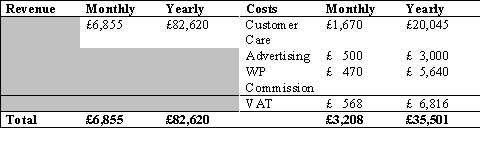
Table 1: scottishdocuments.com
- average revenue and costs.
According to this estimate
the income revenue exceeds the running costs
by approximately 43%. This ratio could be significantly
improved, however, if customer enquiries were
resolved by a dedicated customer service resource,
as previously intimated.
All income revenue received
from the HLF, scottishdocuments.com, and various
other sources, were processed through the project's
accounting system. Each income stream was allocated
a specific account code ensuring that income
from specific sources could be unambiguously
accounted for. Should the project go on to market
additional digital resources, the same accounting
procedures would be used in order to segregate
the income and expenditure associated with particular
resources. This would enable economic activity
associated with the sale of the Wills and Testaments
to be monitored separately from other digitisation
activities, enabling a longer term assessment
of the project's overall effectiveness to be
measured.
8.4.3 Communications
A further critical function
of this role was to provide effective communications
both internally to the project team and externally
to project stakeholders, ensuring that all parties
were kept informed of project developments.
SCAN used shared network drives and also developed
a documentation website to ensure that staff
and HLF had access to all relevant information.
In the early days of the project
a regular newsletter was sent to all participating
archives and a large number of other interested
parties. Once the website was established this
itself became the main means of communicating
progress. In retrospect the project should have
made more effort to publicise progress and keep
in closer touch with participating archives.
This could have been done by copying them the
monthly progress reports that were sent to HLF
without creating an extra task of work.
8.4.4 Value for Money
Looked at any way the project
achieved value for money. All the planned deliverables
(and a large number of additional benefits)
were achieved within the budget originally granted
by the HLF. The project unlocked a major resource
in the GSU contribution. In addition to the
volunteer staff (which underlines the potential
for using volunteers in major archive projects)
the GSU contributed hugely to the development
of the dCam program which enabled the efficient
capture of images. This will be a benefit for
the archive community as it will open up the
prospect of further digitisation programs.
The use of Internet as a delivery
means for archive information has proved much
more cost effective than dealing with physical
visitors. It cannot provide the same level of
personal service for customers, but by providing
self-help tools and facilities, it enables more
people to find out more about themselves, their
communities and their history than they could
by conventional means. In this way, the project
will go on helping to stimulate tourism development
in Scotland at no additional cost.
As the e-Commerce part of
the website is working well, the income stream
from the wills will help to offset future costs
of maintaining the service.
9. Marketing
Activity
The decision to enroll in
Scottish Enterprise's Marketing Advance Programme
played a crucial role in facilitating the project
to identify and define its market segments,
fix a viable price point and inform its longer-term
marketing strategy. The programme also gave
the project access to a Scottish Enterprise
Business Adviser who advised upon business development
strategies and who identified local enterprise
grants that the project may be eligible for.
[View
market analysis report]
The Scottish Documents website was also awarded
best 'Not for Profit' website in the Winners
at the Web 2003 competition.
The decision to contract with
specialist Public Relations and Event Management
Companies was critical in ensuring the success
of the project showcase event and for raising
the public profile of the SCAN project both
within and beyond the Scottish archival community.
The event was well attended and feedback was
very positive. The event attracted a lot of
publicity and was featured on national television
news, national and local
radio and national and local newspapers.
[View
marketing review report]
9.1 Usage Statistics
9.1.1 Expected Usage Summary
During the application to
HLF for funding we were asked to provide projections
for the anticipated usage of the various parts
of the planned SCAN website. We consulted with
several archives already running websites and
scaled our anticipated usage based on their
experience. We expected that, based on existing
experience, the increase in number of users
of websites compared to actual visitors would
range from a two-fold to a ten-fold increase.
The projections at the project planning stage
used the terms 'accesses' and 'visitors'. The
corresponding term for 'accesses' use at the
present time for website statistics is 'page
views' and the term 'visitors' is equated with
the number of "visits" as defined
by the Webtrends software used to analyse usage
figures. The figures below are a summary of
the expected usage we anticipated for each of
the sites main features.

9.1.2 Actual Usage Summary
It is difficult to accurately
subdivide the statistics for specific parts
of the site in the manner predicted to derive
correspondences to the expected usage figures.
As a whole however, we can compare like for
like. The table below summarises the number
of accesses to the SCAN websites.
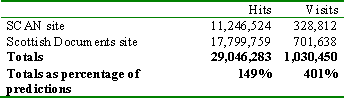
The figures are for the
year 1 January - 31 December 2003.
9.1.3 Catalogue Usage Statistics
The above figures do not include
figures for use of the online catalogue, which
was launched in October 2003. Statistics for
use of the online catalogue are only available
from January 2004, but a projection from data
collected in December 2003 provides the following
figures:
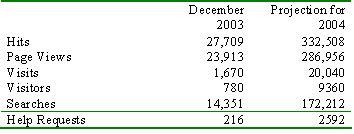
The projection for 2004 is
conservative (based on the December 2003 figure)
as the online catalogue has yet to be fully
publicised.
Usage has clearly exceeded
even the high end original estimates. This has
been partly due to the active promotion of the
site by the Internet Resources team building
on lessons learnt at the Scottish Enterprise
marketing courses. This has shown that where,
for instance, a newsletter is sent out to existing
customers there is a direct correlation between
that and increased sales. This should be noted
by other archives as there is now far more potential
to publicise virtual resources that an archive
may have. This resulting higher profile is something
that archives have long desired. The additional
usage did not cause any issues for the performance
of the website or link. Our specification for
the server hardware was well in excess of the
anticipated high end usage and, in addition,
the equipment itself was well capable of dealing
with a level of usage even beyond that. In practice
the more likely bottleneck would be internet
bandwidth, but with prices for this falling,
we were able to lease a 2Mb connection which
proved more than adequate for our needs. During
the lifetime of the project, therefore, SCAN
was able to benefit from the technological improvements
in server performance and bandwidth availability
to cope with the increase in actual usage over
anticipated usage.
10. Stakeholders
10.1 Directors
SCAN Ltd was set up as a company
limited by guarantee and was responsible for
all the contractual relations between HLF, NAS
and GSU. The company was set up with the Keeper
and his staff intentionally in a minority. Appointing
directors from diverse backgrounds also helped
to throw different perspectives on the way the
project should develop. The directors included
a representative of the participating archives,
a director representing archive users, a representative
from the research community and a representative
of archive owners.
10.2 Participating Archives
Relations with the participating
archive group and the smaller participating
archive working group (PAWG) were complex at
times. There were concerns that the project
would make it more difficult for other Scottish
archive project to gain HLF funding and that
the concentration of resources in NAS was misplaced.
Early staff recruitment in SCAN had, by necessity,
been restricted to NAS staff and there was some
resentment of this. Later recruitment, including
the project manager post, was open to all and
was more satisfactory for participating archives.
Comments were received that the level of communication
was either too much or too little. Participating
archives wanted more control over the project.
To meet these concerns, one of the SCAN Ltd
directors was appointed to represent participating
archives and more responsibility on training
needs (including finance) was devolved to the
PAWG. Despite these difficulties, the project
was able to retain its momentum and gained commitment
from all parties to ensure the projects success.
Towards the end of the project
the participating archives were consulted to
identify the elements of the SCAN project which
they perceived to be the most useful or important
to maintain and develop. Their recommendations
are detailed at Appendix 1.
10.3 User Group
The User Group has been very
supportive of SCAN and has provided valuable
feedback on various aspects of the project.
The User group participated in several evaluations
of SCAN products such as the website, image
quality and the e-Commerce site.
The User group included several
members from the education sector and they were
instrumental in helping to develop the educational
resources in SCAN. In addition, the SCAN user
group formed part of the focus group selected
the NANURG
evaluation.
Even though the HLF project
has been completed, the User Group are keen
to continue their role and maybe broaden it
to consider other archive projects in Scotland.
11. Conclusions
On every measure the SCAN
project has been a success. All the key deliverables
identified in the PID have been delivered and
the project has completed within budget.
The Online Catalogues sub-project
has established a catalogue that comprises fifty
two archives throughout Scotland and is likely
to form the basis of a more extensive cataloguing
conversion project in the proposed Mac2A. Many
archives have received their first computer
equipment courtesy of SCAN which will allow
them to develop their own content and add to
the rich mixture of Scottish archives on the
internet. With the extension of licences for
CALM to more than 20 archives throughout Scotland,
the project has contributed towards cohesion
and consistency in cataloguing that also has
enormous potential for further development.
The Internet Resources sub-project has developed
websites that attract over 1 million visitors
a year with overwhelmingly positive feedback
from the public. They have created a knowledge
base of Scottish archive material which has
been fully illustrated with sample images of
authentic documents. In addition to the originally
proposed deliverables they have created research
tools such as a palaeography website and also
an attractive set of education modules. They
have also used the resources granted to SCAN
to accommodate other related organisations with
both websites and digitising projects undertaken.
The websites will continue after funding has
been completed and have been constructed in
a fashion to facilitate additional material.
The Testaments sub-project
has completed a very ambitious undertaking and
in the process created the very real possibility
that access to all archive material could be
opened up beyond the confines of the buildings
in which they are held. In co-operation with
the GSU they have established a way of working
that helps solve the paradox of preservation
and access at a cost that is at least comparable
to previous methods of photocopying and microfilming.
The level of access to these digitised documents
has proven that there is a huge amount of interest
in Scottish archives. In addition to the above
SCAN has also made significant progress in demonstrating
both the need and potential for archives to
market themselves and their material. Whilst
this cannot be to the detriment of the documents,
digital access has shown that it is possible
to provide a high quality service to far more
people than could ever be accommodated in the
searchrooms of Scottish archives. It should
be noted that, whilst the original aim was to
open up access to Scotland's archives, in practice
family historians have been the principal users.
As a result marketing work and promotion has
been tilted towards that.
SCAN has transformed public
access to archives, substantially improved the
capacity of the archives domain in Scotland,
and provided a model for developing archive
services in the twenty first century.
11.1 Recommendations
11.1.1 Extend Catalogue Access
The Scottish archive community
should build upon the SCAN project and seek
funding to extend the on-line catalogues to
item level, in order to make the country's rich
documentary heritage even more accessible.
At the end of the SCAN project
there is an unprecedented opportunity to build
on the foundations laid by the SCAN Online Catalogues
and the NAS eCat projects and extend the level
of electronic cataloguing throughout the participating
archives to item level. The NAS eCat project,
building on the experience of the A2A project
in England, has established all the working
practices to enable a high quality archival
markup of paper catalogues and have them converted
into a format that is electronically accessible
and searchable. SCAN has provided PCs and cataloguing
software as well as having the starting point
of each collection level record already in place.
There could be very significant economies of
scale in this project involving all the participating
archives and making them available, at least
initially, through the SCAN website until the
archives themselves are in a position to take
over the responsibility. This would be a major
breakthrough for archives and researchers.
11.1.2 Standardisation of
Catalogues across Scottish Archives
The Scottish archive community
should actively work for common standards of
description, based on the rules agreed in the
SCAN project, in order to improve cross searching
by customers, and the export and exchange of
catalogue data by archives.
The Scottish archive community
is now well placed to develop further standardization
of its catalogues. The cataloguing guidelines
developed by SCAN for the fonds level records
should be further developed in the Scottish
archive community to deal with other levels
of description and other types of records. If
there is to be an increase in the level of electronic
catalogues available for searching it is important
that the content standards are developed to
ensure that this enables a meaningful search
to be conducted against very diverse collections.
11.1.3 Development of Other
Online Resources
The Scottish archive community
should continue to work together to compile
and maintain up to date the Knowledge Base entries
created by SCAN, in order to help customers
and improve access to the archives.
The development of the knowledge
base and other resources that exist to help
across institutions should be further developed.
It is becoming increasingly evident that traditional
barriers between organisations make little sense
to the general public. The resources developed
here could be of benefit to all staff in search
rooms throughout Scottish archives.
11.1.4 Develop Digital
Resources
Scottish Archive Community
should consider using the resource established
in SCAN for other large scale digitisation projects
in Scotland.
The SCAN project has established
good working practices that are sound from a
preservation viewpoint are very effective in
throughput and represent good value for money.
If Scottish archives begin to plan, and the
HLF are to fund, other digitisation projects
they should consider using the SCAN model. This
would prevent duplication of effort with other
projects. Other digitisation projects should
also consider the conservation requirements
of their scanning projects.
11.1.5 Encourage Further
Development of SCAN
The HLF should link future
archive grants in Scotland to participation
in Scottish Archive Network.
With such a significant investment
by the HLF it is important that the archive
community generally is encouraged to invest
in this shared resource. The main requirement
for any additional participating archives will
be for them to provide or develop a fonds level
catalogue to the same standards as SCAN has
already developed.
11.1.6 Marketing of
Archive Resources
HLF should require other
archive projects to develop a marketing strategy
HLF should require other archive
projects to develop a marketing strategy (where
appropriate). This was a crucial development
for the SCAN project and has opened up a new
area for archives to promote their existence
and worth.
11.1.7 Genealogical Tourism
Scottish Archive community
should develop further resources that will help
promote Genealogical Tourism
Recognising that family history
is the most popular topic among customers of
Scottish archives, and that tourism linked to
it has been identified as a significant niche
market by VisitScotland, the Scottish archive
community should work to provide high quality
services for residents and visitors, and look
for partnerships at all levels to promote this.
11.1.8 Educational Resources
Scottish archive community
should work with educational authorities to
develop sets of archive material in electronic
form for use in education
Following the model pioneered
by SCAN, the Scottish archive community should
work with educational authorities to develop
sets of archive material in electronic form
for use in learning, particularly at the school
level, in order to support the curriculum, aid
pupils in discovering the history of their communities
and promote knowledge of the documentary heritage.
Appendix 1 Participating
Archives Survey
Summary of Participating
Archives Survey Results (March 2003)
The participating archives
have ranked the following elements in order
of importance:
Online
Catalogues:
1. Maintenance of SCAN's collection level description.
(100%)
2. Development of other catalogue levels. (95.5%)
3. Setting up a Scottish CALM User Group (80%)
4. Technical Support for CALM (76.1%)
5. Archival Support for CALM (70%)
6. General consensus that the NAS should maintain
and expand the name authority files and provide
online access to all participating archives.
Digital
Imaging:
1. Provide a digital imaging service (78%)
2. Provide local access to digital images of
Testaments for your region (70.8%)
3. Provide a subscription service (39%)
4. Other digital imaging services which the
NAS could provide:
- Advice on standards/Technical
Advice
- Digitising records throughout
Scotland that are most at risk of destruction
or dispersal.
- Use of digital imaging
for producing preservation copies of key records
as part of disaster planning.
Internet Resources:
The participating archives have rated the following
features in terms of importance:
1. Archive directory (95.8%)
2. Glossary (62.4%)
3. Guide to Record Types (58.2%)
4. Knowledge Base (58.2%)
5. Gazetteer (41.6%)
The participating archives
have rated the following services in order of
importance:
1. Useful Links (87.4%)
2. Family History Guide (66.6%)
3. Online Exhibitions (45.7%)
4. Virtual Tours (24.9%)
5. Discussion Forum (16.6%)
6. Bookshop (12.4%)
The participating archives
rated the following proposed additions to the
SCAN site in order of importance:
1. Database indexes of other record series (74.9%)
2. Digital version of other record series (54.1%)
Other Useful Services
and General Comments.
Other online services, which
may be of value:
- Information as to the purchase
of equipment and professional supplies and
advice on conservation matters would be really
useful as would guidance on access (or closure)
of record series and types (specific cases)
under the legislation on Data Protection and
Freedom of Information. It would really aid
a consistent approach to know NAS policy on
an issue-by-issue basis.
- Any health records/databases/source
lists/links etc. i.e. Organisational/institutional
records such as health boards, health authorities,
hospitals, clinics, remote services etc.
- Should be a section relating
to promotion of archives to schools and colleges
of further education etc.
- Research on scottishdocuments.com
also useful, could the two be continued on
a single site.
- Online sources are correctly
aimed at users, not at archives. The main
use we have for Internet resources is to help
users find sources and addresses. Gazetteers
and Administrative histories would be useful.
General comments:
- The highlighting of documents,
advice on handwriting, FAQs and information
about archival events are all valuable features
of the website that should be continued. Highlighting
changes in archival legislation or other significant
new matters affecting archives would be useful
to add to the site.
- The Scottish handwriting
tips/tutorial on the Scottish documents site
& currency converter are very useful and
several of our users have found then useful.
It would be good to see more practical features
like that.
- Wider links - HE Hub, aim
25 etc - seamless searching for researchers.
- Online advice to owners
of records to assist the work of NRA(S) in
disseminating information on their care and
possible deposit in an appropriate repository.
- Important to retain the
momentum SCAN has so ably provided. Who can
foresee what possibilities technology might
provide in the mid-term - Scotland's archive
provision needs to be well placed, through
SCAN's experience, to benefit from them.
- Advice to owners on care
of records and deposits in local repository,
help available from local archives.
Appendix 2 SCAN and HLF Credits
As has been noted in the report,
one of the critical factors in ensuring the
successful completion of the project has been
the contribution made by the staff involved.
Some have been involved a little, others a lot,
but the project is the sum total of all their
work.
SCAN Staff
| Ishbel Barnes |
Project Manager |
| George MacKenzie |
Liaison with NAS |
| Rob Mildren |
Project Manager |
| |
|
| Bill Paton |
IT Officer |
| Niall Taylor |
IT Officer |
| Stuart Low |
Project Administrator |
| Kirsty McKay |
Project Administrator |
| Alex Holstead |
IT Officer |
| |
|
| Alan Borthwick |
Online Catalogues Team Leader |
| Jo Peattie |
Online Catalogues |
| Rachel Third |
Online Catalogues |
| John MacKenzie |
Online Catalogues |
| Caroline Brown |
Online Catalogues |
| Jenny Cutts |
Online Catalogues |
| Helen Kemp |
Online Catalogues |
| Alison Diamond |
Online Catalogues |
| Nicola Mills |
Online Catalogues/Wills & Testaments |
| Mark Mulhern |
Online Catalogues |
| Gordon Pentland |
Online Catalogues |
| Catherine McDonald |
Online Catalogues |
| Katie Russell |
Online Catalogues |
| Jane Jamieson |
Online Catalogues |
| Andrew Jackson |
Online Catalogues |
| Lesley Doig |
Online Catalogues |
| Alistair Hunter |
Online Catalogues |
| George Anderson |
Online Catalogues |
| |
|
| Joanna Baird |
Internet Resources Team Leader / Project
Development Manager |
| Robin Urquhart |
Internet Resources Team Leader |
| Sam Scanlin |
Internet Resources |
| Victoria Miller |
Internet Resources |
| Clive Birnie |
Internet Resources |
| John Malden |
Internet Resources |
| Gary Clelland |
Internet Resources |
| Maxine Wright |
Internet Resources |
| Gary Young |
Internet Resources |
| |
|
| Hazel Anderson |
Wills & Testaments Team Leader |
| Margaret Fox |
Wills & Testaments |
| Jane Hill |
Wills & Testaments |
| Charles Kelham |
Wills & Testaments |
| Paul Hopkins |
Wills & Testaments |
| Ralph Moffat |
Wills & Testaments |
| Peter Dickson |
Wills & Testaments Conservation |
| Dagmar Hinz |
Wills & Testaments Conservation |
| Ann Gibson |
Wills & Testaments Conservation |
| |
|
| Jim Oakley |
GSU Supervisor |
| Bob Blakely |
GSU Volunteer |
| Louann Blakely |
GSU Volunteer |
| John McLaws |
GSU Volunteer |
| Nancy McLaws |
GSU Volunteer |
| Wayne Brossard |
GSU Volunteer |
| Alice Brossard |
GSU Volunteer |
| George Kayser |
GSU Volunteer |
| Marolyn Kayser |
GSU Volunteer |
| Larry Upham |
GSU Volunteer |
| Mary Upham |
GSU Volunteer |
| Jay Daines |
GSU Volunteer |
| Lucy Daines |
GSU Volunteer |
| Stephen Jackson |
GSU Supervisor |
| Gayle Guinn |
GSU Volunteer |
| Diane Guinn |
GSU Volunteer |
| Gloria Chaston |
GSU Volunteer |
| Norton Chaston |
GSU Volunteer |
| Grant Miller |
GSU Volunteer |
| Arlene Miller |
GSU Volunteer |
| Kay Marshall |
GSU Volunteer |
| Ray Marshall |
GSU Volunteer |
| Leland Maylin |
GSU Volunteer |
| Sharon Maylin |
GSU Volunteer |
| KD Smith |
GSU Volunteer |
| Jacqueline Smith |
GSU Volunteer |
| Glen Butterfield |
GSU Volunteer |
| Lois Butterfield |
GSU Volunteer |
| Bob Erskine |
GSU Volunteer |
| Joy Erskine |
GSU Volunteer |
| Michael Mitchell |
GSU Supervisor |
| Elno Fluckiger |
GSU Volunteer |
| Karen Fluckiger |
GSU Volunteer |
| Arlene Baker |
GSU Volunteer |
| Moe Baker |
GSU Volunteer |
| |
|
| HLF |
|
| Michael Smethurst |
Project Monitor |
| Seamus Ross |
Project Monitor |
| |
|
| Jane Stancliffe |
SCAN Project Case Officer |
| Henrietta Ryott |
SCAN Project Case Officer |
| Beverley Peters |
SCAN Project Case Officer |
| Helen Wheatley |
SCAN Project Case Officer |
| Caroline McIntyre |
SCAN Project Case Officer |
| |
|
Appendix 3 Impressions
Below are a range of different
views of the SCAN project. A number of people
were asked to contribute their views of the
project whether positive or negative and comment
on how the project had an impact on them. We
asked views from former employees, participating
archives, members of the user group, GSU volunteers,
outside organisations that were involved in
the development and customers. All comments
have been included unedited.
Cathy Black, Scottish Enterprise
Edinburgh & Lothians
Scottish Enterprise became
involved with The Scottish Archive Network at
the time when the project was in its infancy.
SE's role was very much to be a sounding board
for the strategic development of SCAN and also
to provide practical assistance with respect
to marketing and IT issues. Through Scottish
Enterprise, SCAN secured the assistance of an
ecommerce adviser who helped to pilot the site
to a select group of known users. This was done
in order to test the on-line ordering process
and also the internal systems within SCAN for
monitoring the project. With some initial teething
issues ironed out, SCAN launched the site worldwide.
It is all credit to the team at SCAN that they
took a unique project idea and turned it into
a commercial reality.
Iain Flett, Dundee
City Council Archives
Our experience of the Scottish
Archive Network here in Dundee has been totally
positive. The generous offer of website provision
and design to both the Abertay Historical Society
and to the Friends of Dundee City Archives,
both of them charitable societies who would
have been hard pressed to envisage hosting them
on their own resources, has generated interest
in all of their respective activities. The FDCA
website has indeed generated so much interest
and feedback that it is now causing the Friends
welcome problems on how to deal with this. A
computer, printer and scanner have been provided
for public use in the searchroom, for which
all members of the public have been incredulously
grateful that such a facility is freely available
to them to continue their archival search on
the internet, as well as searching the databases
which the FDCA have created. A SCAN member of
staff also spent a substantial term converting
the old foolscap typed catalogues into electronic
form, again an exercise which Dundee City Archives
would never have had the resources to carry
out. The SCAN website facilities of the archive
directory, of the research tools, and of the
online catalogues have made life a lot easier
both for ourselves and for our enquirers, and
we hope that SCAN will continue to be developed
for the greater good of Scottish education and
historical understanding. While appreciating
the usefulness of present and future pay-as-you-go
sections such as Scottish
Documents we would be concerned that the
ethos of any future SCAN development will be
free access to information for all members of
the community. Yours sincerely, Iain Flett
Glenn & Lois Butterfield,
GSU Volunteers
We have enjoyed working with
the SCAN project for basically two reasons beyond
the enjoyment of associating with many of the
fine and dedicated personnel employed by SCAN.
As serious genealogists since
1958 we have seen the resources develop from
a few thousand microfilms to the marvelous technologies
of digital imaging and instant on-line gratification
of information. It has been exciting to be on
the leading edge with the SCAN project. Our
second focus comes from having been extractors
from documents others have filmed. Now, we have
participated at the beginning of the process
and appreciate the work that goes into document
preservation and recording. From our point of
view the SCAN project is an example to the world
of research. The standards of quality and variety
of material available is recognized by the thousands
of hits on the web system.
Caroline Brown, University
of Dundee Archives & Former SCAN Staff
The SCAN project was unique
in Scotland as it was cross-sectoral. As such
it allowed public, university and archives of
other organisations to work together towards
a shared goal. As a worker on the project, this
was an aspect that I particularly appreciated.
It allowed the already close archival sector
to move towards a common standard on several
issues. On a personal level I appreciated the
closer ties that my time with SCAN gave me with
colleagues throughout Scotland. Although at
times it seemed that the project would be much
bigger than staff resources would allow, the
completion of the project has provided a solid
base on which to found future developments.
Stephen Jackson, GSU
Supervisor
This was my first experience
of digital imaging for commercial / archival
purposes and even the cameras were new to me.
The project had been up and running for over
12 months when I arrived and so any initial
problems had been addressed e.g. colour balance.
It was a very rewarding time for me being able
to supervise the GSU volunteers and work closely
with SCAN and NAS personnel, and to see and
participate in the 'behind the scenes' work.
Having been involved with microfilming for more
years than I care to remember I know the importance
of reducing the handling of documents and having
had the experience of working at SCAN can see
the great potential and problems digital imaging
has.
.
It was obvious a great deal of thought and effort
had been invested in the planning of the project,
and listed are some of the points ( in no particular
order ) that I believe have helped to make the
Testament project such a success
1 File name same structure as catalogue entries;
2 Database entries having unique references;
3 Metadata database with all relevant data of
volume, camera settings etc.
4 Capture of three images R G B to produce a
colour image instead of single shot;
5 The final use of images both for internet
use and search room use
6 The software systems in use have been robust
enough to have a number of extras incorporated
that became evident with time would make entering
data easier for the volunteers
7 The mechanism for selling images over the
internet.
8 The cooperation of conservation, archivists,
reps, physical facilities, I.T. personnel, and
volunteers.
For me it was a very rewarding
and enjoyable experience and I would like to
thank all those I worked with for their kindness
and help.
Ishbel Barnes, Initial
Project Manager
SCAN has now achieved what
it set out to achieve. It has done it within
budget and virtually within the projected timescale.
Its effect on the study of Scottish history
will be, I believe, very great as its potential
is gradually realised by everyone interested
in the history of our country. On a personal
note I am very proud of the work of my former
colleagues. It is perhaps invidious to single
out individuals in what was essentially a team
effort, but I remain especially grateful to
Mrs Hazel Anderson, Ms Joanna Baird, Dr Alan
Borthwick, Mr Robin Urquhart and most of all
to Mr Rob Mildren.
Ray Marshall, GSU
Volunteer
I write as one of the GSU
volunteers working on the SCAN Testaments digitizing
project. At the outset, let me just say that
when we first learned we would be working on
the project, as volunteers, working in Scotland,
we were truly excited. When we arrived in Scotland
and met the SCAN staff we were made right at
home, and after a short time to get up to speed,
found ourselves immersed in the project.
I suppose some people would
find little excitement or interest in turning
a page and capturing an image, but to us it
was much more than that. Our immediate focus
was the books, but the real interest was in
the people whose lives were documented in those
books, and the influence they had on modern
day Scotland and the Scottish people. We didn't
have time to read much of the material, but
in the few seconds it took to capture each image
we did have the chance to briefly scan the pages
we were capturing. When something of real interest
caught our eye, we would stop to read a little.
We know that this affected our productivity
a little, but as volunteers we considered this
a little payback for the effort we were putting
into the project. The things we read as we captured
wills and testaments truly opened our eyes to
the rich heritage of the Scottish people --
their loyalty to their country, their love of
their families, and their faith in God. In a
modern day when all three of those are under
attack, it was refreshing to look back on the
rich heritage of Scotland, and feel some satisfaction
that much of that heritage shows through to
modern times, despite appearances as reflected
in the media.
We were pleased with the administration
of the project and the great care taken to be
sure that we were comfortable and our needs
were met. It was therefore a truly enjoyable
experience, from all aspects.
Elizabeth Gabriel,
Customer
It is difficult to find anything
on the down-side to say about this site. It
is a marvellous research tool and window into
the past. The image quality is excellent (allowing
for the condition of the originals which necessarily
varies) and when it comes to the older manuscripts,
it is even more like looking at the original
with all the stains of time.
The content naturally varies
tremendously in both length and interest. It
can be disappointing, especially for those who
died intestate, where the document merely lists
assets and debts for tax purposes, but gives
no leads. Others are a gold mine of information,
leading to unknown relatives and showing the
almost invariable thrift of our ancestors, nearly
all of whom seem to have had savings deposits
at some of the many banks even when obviously
not well off. The lists of contents of their
houses can be quite fascinating, from 8-day
clocks to buckets of coal.
I have just two small criticisms
regarding the mechanics of the site which I
would like to see adjusted: When you have an
unsuccessful search, but wish only to alter
perhaps one word, or the court concerned, you
have to start from scratch each time - it would
be helpful for the initial input to be left
for alteration.
(b) when you get to the foot
of a page of wills, it would be helpful to be
able to go back a page without having to go
to the top of that page first.
Otherwise, a gem of a site.
Keith Withington,
Account Manager Genealogical Society of Utah
The Genealogical Society's
involvement in this project has from the outset
been one of a steep learning curve. Some five
or more years ago the Society was considering
there should be a move towards digital imaging
rather than microfilm as a means of accessing
information. The SCAN project has assisted that
decision making process. From its early days
when our staff considered how they would fill
their time to the present day when they could
use more hours we have gained experience and
knowledge. We are better equipped ourselves
to commence, with confidence new imaging projects.
A number of our employees have gained valuable
skills that can be used in our organization,
as will be manifest in another joint project
soon to commence. The project has also been
a great vehicle for introducing many archivists
to new technology and allowed them to understand
more fully the role of imaging and then Internet
access of the images.
As an organization we have
always received good feedback from all thestaff
involved. Concerns have been dealt with promptly
allowing the throughput of work to continue
in a timely manner. Importantly information
has been shared so that all concerned could
learn from the project as a whole. From a personal
point of view it has been a pleasure to work
with SCAN personnel.
Ann Laird, Chair SCAN
User Group
Thanks to SCAN, there are Scottish Wills and
Testaments, as well as "Finding Aids"
for archival holdings in 50 Scottish archives,
now globally available on internet websites,
with on-line support from an expert "knowledge
base" and tutorials in historic handwriting.
The User Group has observed the commitment,
skill and high standards of the SCAN team in
moving Scottish Archives into the world arena.
Throughout the project, SCAN has consistently
taken its liaison with its User Group seriously.
Wide-ranging interests, including genealogy,
local history, schools, tertiary sector, national
archives and ICT were represented in those invited
to join, and occasional joint meetings with
the Participating Archives group were very productive.
While providing a "reality check"
for the expenditure of large sums of public
money, User Group members have been able to
enjoy a close-up view of a major innovation,
with the opportunity to influence it.
Feedback from the User Group
informed a SCAN decision to invest in educational
materials: a set of primary sources from Scottish
archives can now be accessed on-line, with learning
materials suited to Scottish schools. User Group
members participated directly in specifying
and implementing this work.
From the User Group perspective,
HLF Monitors have appeared overly bureaucratic
and slow to grasp opportunities to improve the
project as it developed. HLF funds are for the
people, and everyone wants to ensure that public
money is spent efficiently - but HLF will find
it difficult to source appropriate work in future
unless it can develop a more collaborative approach
and use a 'lighter touch' in its monitoring
methods.
User Group meetings have become
approximately quarterly and attendance settled
to a regular handful representing the main interests.
Other members attend occasionally, make email
responses, and are contacted directly by project
staff. As Chair of the group, I feel our contribution
to the main project has been genuinely valued:
we are now interested in developing an effective
support role in the post-project phase.
Jay & Lucy Daines,
GSU Volunteers
We remember with fondness
our time spent working on the SCAN project.
The first several months while we were figuring
out how to get the equipment working properly
was, of course, a bit frustrating. Since returning
to Utah we have received many positive comments
from people searching for Scottish ancestors,
and there are many people here doing just that!
The technology that was developed for the project
will most certainly be highly valued now and
in the years to come.
Lynn Beaumont Tods Murray - SCAN Legal Advisors
Tods Murray (Lynn Beaumont
and Richard Findlay) have acted as legal advisers
to SCAN since 1998 and have been involved in
each stage of the project - from setting up
the company and documenting the funding, documenting
arrangements with National Archives of Scotland
and GSU, right through to advising on aspects
of the commercial site scottishdocuments.com.
One of the most interesting
aspects of the project for us in the early days
was intellectual property right licensing and
ownership. As the first project of its kind,
and at a time when the legal niceties of copyright
in the digital era were perhaps less explored
than now, it was very much a case of working
from first principles. Particular issues for
us included the use of Crown copyright materials
in this context and ownership of copyright in
digital materials.
From a personal point of view
we have very much enjoyed working with Ishbel,
Rob and the rest of the team over the years
- and our knowledge of matters such as finding
aids and palaeography has increased tremendously
as a result!
Hector L MacQueen,
Chair; Scottish Records Advisory Council
The SCAN project is an exciting
realisation of the potential of the digital
environment to transform the way in which we
access, use and understand the records of the
past. The Scottish Records Advisory Council,
which has a statutory duty to promote public
access to, and understanding of, public records
has long seen SCAN as a superb way to take this
mission forward. From the point of view of the
public, this is a quick and easy way to get
into the records from the comfort of your own
home, before making your way to the archive
to examine the documents you have traced through
SCAN. From the point of view of the teacher,
whether in school, college or university, here
is a wonderful opportunity to bring the records
into the classroom. And from the point of view
of the researcher, in particular the social
and legal historian, SCAN opens the way into
the wonderful centuries-long resource that is
the wills and testaments. It is to be hoped
that SCAN is only the beginning of a new way
of appreciating the wealth to be found in our
public archives.
Appendix 4 Securing the Future for the SCAN
Digital Assets
The SCAN project will be largely
completed by end February 2004 and 31 March
2004 is the final date for project funding.
NAS recognises the immense value of the digital
assets the project has created with generous
HLF investment, and is committed to maintaining
and developing them for the benefit of all Scottish
archive users.
The SCAN top-level catalogue
effort will be largely complete by 29 February
2004, and NAS undertakes to complete any editorial
work remaining when project funding ceases.
Responsibility for updating entries will thereafter
transfer to the participating archives, but
NAS will maintain the catalogues and process
new and revised top level entries. NAS is also
committed to supporting the efforts of participating
archives to deepen their catalogues to item
level through projects such as Mac2A, and through
providing training opportunities for Scottish
archivists. NAS will continue to provide a Help
Desk service to participating archives for any
queries regarding their CALM installation.
NAS will take over and maintain
the digital cameras from March 2004 and will
offer a digitising service to participating
archives and related heritage institutions in
Scotland. Details are below. NAS will negotiate
with the GSU to continue their involvement in
digitising Scottish archives and expect to conclude
an agreement to work on indexing and imaging
church records.
NAS will take over the e-commerce
service, Scottishdocuments.com, from March 2004.
This will in time be transferred into the new
Scottish Family History Service which NAS are
developing with the General Register Office
Scotland and the Lord Lyon. Public access will
be on the same principles as operate at present
with SCAN.
The on-line services will
be continued by NAS as assets of value to all
archive users in Scotland. NAS will continue
to encourage participating archives to submit
up to date information for the directories and
the knowledge base, and will process and add
these.
SCAN has sought the views
of the participating archives on which aspects
of the project they wish to see continue and
in what form. NAS will take these views into
account in its future work with the participating
archives.
The directors of SCAN Ltd
have agreed to investigate options for continuing
the company in existence as a vehicle for encouraging
further development of archives across Scotland.
This includes backing the application by the
Scottish Council on Archives for project development
funding for Mac2A.
NAS Digitisation Service
NAS have agreed to take over
and maintain the 5 digital cameras provided
by the SCAN project with HLF funding, and to
provide a digitising service for participating
archives and related heritage institutions in
Scotland. This note sets out the principles
for providing that service.
SCAN has, with HLF funding
and generous technical support of the Genealogical
Society of Utah, developed sophisticated facilities
for swift digitising from original archive documents.
The key elements in this include the software
for controlling the cameras and the workflow
procedures, covering preparation with appropriate
preservation input, digital capture, quality
control and, where appropriate, linking of images
to indexes or other finding aids.
These facilities have up till
now been used to digitise some 2.5 million images
from Scottish wills, and during the second half
of 2003 they will also be used for poor law
records from across Scotland and later for Kirk
session records held by the NAS under an agreement
with the Church of Scotland.
There may, however, be some
spare capacity available, and NAS intends to
use this to offer a service firstly to archives
that participate in the SCAN project, and secondly
to related heritage organisations that require
archive documents to be digitised.
The provision of the service
to will be subject to pressure of work on the
other material and at the discretion of the
NAS. Material which, in the opinion of NAS conservation
staff, requires treatment may be declined or
require to wait until such treatment can be
given.
NAS will maintain and repair
the cameras as necessary for at least 5 years
from the time of original purchase, which represents
the full period of depreciation. Beyond this
period, NAS aims to replace the cameras when
required and to continue to provide a digitising
service.
NAS will require to recover
all costs associated with providing the service,
including any conservation work required, and
this will be reflected in the price charged
to institutions using the service.
Appendix 5 Project Monthly Reports
Each month the project sent
a report to the HLF which detailed the finances,
performance indicators and a commentary on major
events in the project. Listed below are links
to each of the reports which details many of
the highs and lows of the project.
Appendix 6 Glossary
| A2A |
The Access to Archives project.
This offers access to archives catalogues
in England and Wales. http://www.a2a.org.uk/ |
| ARKIS |
This is the cataloguing software developed
by the Riksarkivet in Sweden |
| CALM |
CALM is a database for archive catalogues
- http://www.ds.co.uk/calm.html#archives |
| DS |
DS Ltd is the company responsible for
developing CALM |
| EAD |
Encoded Archival Description, a means
for standardising the interchange of archive
information. http://www.loc.gov/ead/ |
| e-Cat |
This was an NAS project to convert the
entire paper catalogue into electronic form. |
| FDCA |
Friends of Dundee City Archive http://www.fdca.org.uk/ |
| GSU |
Genealogical Society of Utah - an organisation
dedicated to gathering, preserving, and
sharing genealogical information throughout
the world http://www.gensocietyofutah.org/ |
| HE |
Hub Higher Education Hub. The Archives
Hub provides a single point of access to
descriptions of archives held in UK universities
and colleges. http://www.archiveshub.ac.uk/ |
| HLF |
Heritage Lottery Fund. HLF uses money
from the National Lottery and give grants
to support a wide range of projects involving
the local, regional and national heritage
of the United Kingdom http://www.hlf.org.uk/ |
| ISAAR (CPF |
International Standard Archival Authority
Record for Corporate Bodies, Persons, and
Families. This standard gives general rules
for the establishment of archival authority
records that describe the corporate bodies,
persons, and families that may be named
as creators in descriptions of archival
documents. http://www.ica.org/biblio/isaar_eng.html |
| ISAD(G) |
General International Standard Archival
Description. This standard provides general
guidance for the preparation of archival
descriptions. It is to be used in conjunction
with existing national standards or as the
basis for the development of national standards
http://www.ica.org/biblio/isad_g_2e.pdf |
| Mac2A |
This is a proposed project for Scottish
archives based on similar principles to
A2A see above. |
| NANURG |
National Archives Network User Research
Group, a working group of the National Council
on Archives carried out user evaluation
research into the main strands in the UK
archives network including SCAN http://www.resource.gov.uk/documents/nanurg.doc |
| NAS |
National Archives of Scotland http://www.nas.gov.uk |
| NLS |
National Library of Scotland http://www.nls.uk |
| OPAC |
Online Public Access Catalogue |
| PAWG |
Participating Archives Working Group |
| SCAN |
Scottish Archive Network http://www.scan.org.uk |
| TNA |
The National Archives http://www.nationalarchives.gov.uk/default.htm |
|